How to Find Out What Your Pokemon Card Collection is Actually Worth
Because "probably a lot" is not a number.
By Misprint Editorial | Published Feb 2, 2026 | 7 min read
Because "probably a lot" is not a number
We get asked this question more than any other: "How much are my Pokémon cards worth?" Usually it's someone who just found their childhood binder, or someone whose kid moved out and left 2,000 cards behind, or someone who bought a collection at a yard sale and is hoping they struck gold. We've been through the process of checking Pokémon card values enough times that we could probably do it in our sleep. (One of us has actually dreamed about sorting cards before. This hobby does things to your brain.)
The honest truth is that most Pokémon cards are worth very little. Like, pennies. Out of a collection of 1,000 random cards, you might have 20 that are worth looking up and maybe 5 that are worth more than a couple bucks. But those 5 cards can sometimes be worth more than the other 995 combined, so it's definitely worth going through the exercise. We've seen people pull $300 cards out of shoeboxes they were about to throw away.
Start by Sorting Your Collection
Don't just grab a random card off the top and start Googling. If you've got more than 50 cards, you'll save yourself a ton of time by doing a quick sort first.
Pull out every holographic card. If the artwork is shiny or has a texture to it, set it aside. These are the cards that are most likely to have value.
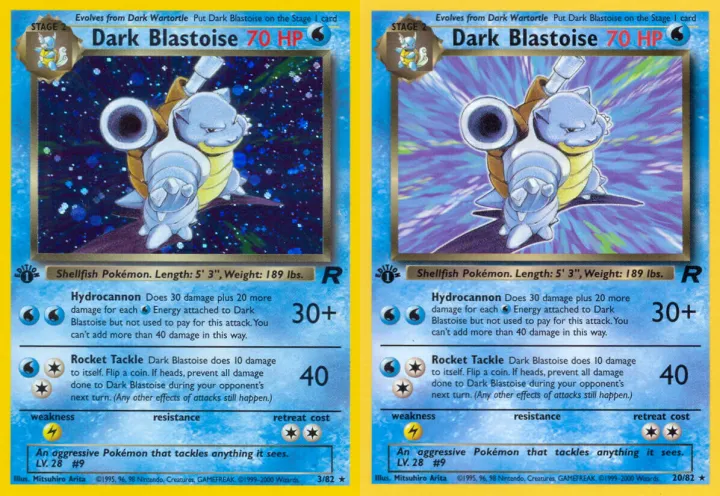 Holographic (left) vs non-holographic (right). Image courtesy of PKMNcards.com
Then look for cards that just look... different:
- Full-art cards where the artwork goes all the way to the edges
- Cards with a gold or rainbow color scheme
- Cards with a textured surface you can feel when you run your finger over it
- Anything that looks fancier than a standard card layout
These are your "secret rares" and "special illustration rares" and whatever else The Pokémon Company has decided to call the fancy cards this generation.
For everything else, check the rarity symbol in the bottom corner:
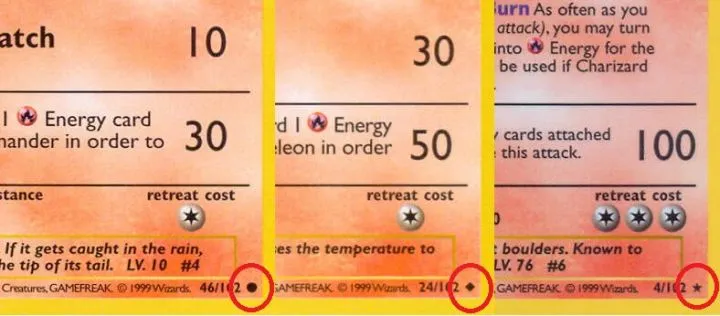 Card image courtesy of PKMNcards.com
- Circle (●) = common
- Diamond (◆) = uncommon
- Star (★) = rare
- Multiple stars or letters like "SR" = special rarities
Anything with a star or above goes in the "worth looking up" pile. Commons and uncommons you can pretty safely ignore unless they're from sets printed before 2003 or so.
You should now have two piles: a small "check these" pile and a big pile of bulk. The big pile is worth maybe $3-5 per thousand cards if you sell it as bulk. Not zero, but not exactly retirement money either. Your focus should be on the small pile.
How to Check Pokémon Card Prices (The Right Way)
This is where most people mess up when trying to find the value of their Pokémon cards, and we really need to stress this point: the price a card is listed for and the price it actually sells for are not the same thing.
They can be wildly, comically different. We have seen people list a card on eBay for $500 that routinely sells for $60. Those people are out of their minds, but their listings still show up in search results, and if you don't know better, you might think your card is worth $500 too. It's not.
You want sold prices. Actual completed transactions where money changed hands.
Best Tools for Checking Pokémon Card Values
Misprint is what we'd recommend for checking Pokémon card prices (yes, we're biased, but hear us out). It works for both graded and ungraded cards, and for graded cards especially, it's the best tool we've found. You get:
- Historical sales data and price trend charts, so you can see if a card is at a high point or a low point
- Pop report data showing how many copies exist at each grade (so you know if your PSA 10 is truly rare or if there are 12,000 of them)
- Pricing for ungraded cards too, so it works as a one-stop shop
The price history charts are really nice for understanding where a card sits in the market, which is something other tools don't show you as clearly. We find ourselves using Misprint more and more as our default for looking up card values.
TCGplayer is the other standard for ungraded Pokémon card prices. Their "Market Price" is calculated from real sales and it updates constantly. Just search for your card and there it is. TCGplayer also has a free app with a card scanner if you'd rather point your phone camera at the card instead of typing.
eBay Sold Listings are great for a second opinion. Go to eBay, search for your card, and filter by "Sold Items." This shows you what the card has actually sold for recently. We use this all the time, especially for cards that are uncommon enough that they don't have a lot of data elsewhere.
One thing to watch out for on eBay: don't just look at the highest or lowest sold price. Look at the pattern across several sales to get a realistic number. And absolutely never, ever use the lowest listed (unsold) price on eBay as your reference. This is one of the most common mistakes we see people make and it leads to a lot of heartbreak.
Other Useful Pricing Tools
- Alt is great for seeing the most recent eBay and auction sales for graded cards
- 130point.com is the move for sealed products like booster boxes or Elite Trainer Boxes, since sealed product listed prices on eBay are frequently way higher than what things actually sell for
Pokémon Card Condition (This Matters More Than You Think)
When you look up a Pokémon card price on TCGplayer, the "Market Price" assumes your card is Near Mint. If your card has been shuffled into decks, tossed into a drawer, or chewed on by your dog, it is not Near Mint. And the price difference can be steep.
Here's the condition scale for ungraded Pokémon cards:
- Near Mint (NM): Looks essentially perfect to the naked eye. This is the baseline price you see online.
- Lightly Played (LP): Small signs of wear. Expect 10-20% less than NM price.
- Moderately Played (MP): Noticeable wear on edges and surface. Expect 30-50% less.
- Heavily Played (HP): Significant wear throughout. Expect 60-80% less.
- Damaged (DMG): Major structural issues. Some buyers won't touch these at all.
We know it's tempting to look at your card with its whitened edges and minor surface scratches and say "that's Near Mint, right?" It's not. Be honest with yourself. If you overgrade your cards and then try to sell them, the buyer is going to notice and either return the card or leave you a bad review. Neither is fun.
TCGplayer's condition guide is the standard most sellers use, and there are also plenty of YouTube videos walking through visual examples if you want to see what each condition grade actually looks like in practice.
What About Vintage Pokémon Cards?
If you've got cards from the late 90s or early 2000s, especially anything from Base Set, Jungle, Fossil, or Team Rocket, pay extra attention. These are the Pokémon cards that can be worth real money, but they're also the ones where condition matters the absolute most.
A 1st Edition Base Set Charizard in Near Mint condition is a five-figure card. That same card in Heavily Played condition is worth a fraction of that. This is an extreme example, but the principle applies to basically all vintage holos.
A lot of the time, people find their childhood cards and assume they're in great shape because they look "fine," but fine to your eyes and fine to the grading companies are very different standards:
- Centering (is the border even on all sides?)
- Surface scratches you can only see at an angle
- Tiny edge nicks or whitening
- Corner wear
All of that counts. If you think you might have something genuinely valuable from the vintage era, we'd recommend having someone experienced look at it before you make any decisions. A local game store, a trusted collector friend, or even just posting a picture in a Pokémon card community on Reddit can help you figure out whether it's worth getting graded.
Adding Up Your Pokémon Collection Value
Once you've priced out the good stuff, you can add it up and get a rough total for your collection's value. A few things to keep in mind:
- Your total is higher than what you'd actually get. If you sell each card individually at market price, you'll get close to the full number, but that takes time and effort. If you sell as a lot or bring everything to a card shop, expect to get 50-70% of the individual values, maybe less.
- Bulk cards add up slowly. Hundreds of commons and uncommons might be worth $3-5 per thousand. Not nothing, but not a windfall either.
- Prices change. Newer cards can fluctuate a lot in the first few months after release. Vintage Pokémon cards tend to be more stable, but even they shift with the market. The number you get today is a snapshot, not a guarantee.
And if it turns out your Pokémon card collection isn't worth much? That's OK. Most aren't. But now you know, and you didn't have to pay anyone to tell you. And if it turns out you're sitting on something special? Congratulations. Please put it in a sleeve immediately. We're begging you.