Best Place to Track Pokemon Card Values Over Time (Tools Compared)
Checking a price once is easy. Tracking it over time is where the real insight lives.
By Misprint Editorial | Published Mar 1, 2026 | 12 min read

Knowing a card is worth $200 today tells you almost nothing. Knowing it was $120 six months ago and $280 three months ago tells you everything.
There's a difference between checking a card's price and tracking a card's value. Checking is a snapshot. Tracking is a movie. And if you're collecting with any intent to buy, sell, or hold strategically, you need the movie.
We talk to collectors every day who made buying or selling decisions based on a single price check — and regretted it. They sold a card that was in a temporary dip. They bought a card that was at a temporary spike. They held a card through a slow decline because they never noticed the trend. All of these mistakes could have been avoided with basic value tracking.
This guide compares every major tool for tracking Pokemon card values over time. We'll cover what kind of data each tool provides, how far back their history goes, whether they offer portfolio management, and what they're actually best for.
Why Tracking Values Over Time Matters
If you just want to know what your card is worth right now, any of the tools in our price checking guide will do the job. Tracking over time solves different problems:
Timing Buys and Sells
Pokemon card prices are cyclical. Most modern cards follow a predictable pattern: prices spike at release, drop over the following weeks as supply increases, stabilize, and then either gradually decline or (for chase cards) slowly climb as sealed product dries up. Understanding where a card sits in this cycle helps you avoid buying at the top.
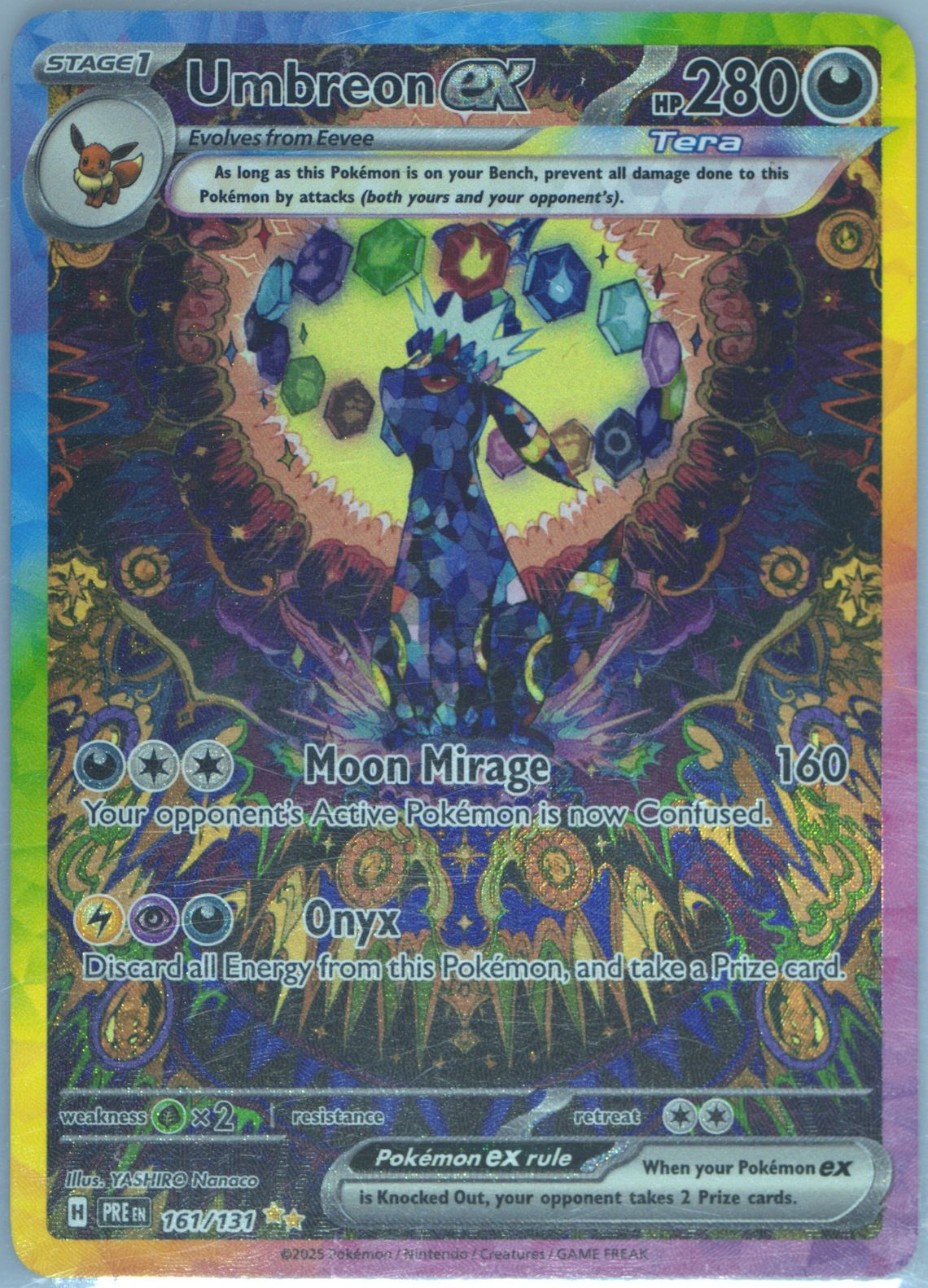
For example, the Prismatic Evolutions Umbreon ex SIR followed this exact trajectory. If you tracked its price from release, you'd have seen the initial hype pricing, the correction, and the stabilization point. Buying during the correction saved you 30-40% compared to buying during release week.
Identifying Market Trends
Individual card tracking rolls up into broader market intelligence. When you track multiple cards from the same era, you start to see whether the vintage market is heating up or cooling down, whether modern chase cards hold value or bleed over time, and whether certain card types (alt arts, SIRs, gold cards) trend differently from each other.
We covered broader market movements in our 2026 market trends piece, but your own tracking data gives you a personalized view that no generalized article can match.
Portfolio Management
If you have more than a handful of valuable cards, tracking their combined value over time turns a collection into a managed portfolio. You can see your total collection value change month over month, identify which cards are dragging performance down, and make informed decisions about rebalancing (selling deprecating cards and buying appreciating ones).
Knowing When to Grade
This one is underappreciated. If a raw card's value has been climbing steadily, and the PSA 10 version commands a 3x premium, that trend data helps you decide whether it's worth paying for grading. If the trend is flat or declining, the grading cost might not be justified. The PSA 10 vs PSA 9 price differences compound this decision.
The Tools, Ranked for Value Tracking
1. Misprint — Best Price History Charts for Graded Cards
Misprint's price history charts are on every card page. Pull up any graded card, and you'll see a chart showing how its sold price has moved over time, broken down by grading company and grade.
What makes it stand out for tracking:
- Grade-specific charts. You don't just see "Charizard price over time." You see PSA 10 price over time, PSA 9 price over time, and CGC 9.5 price over time — as separate data series. This matters because different grades can trend differently. A PSA 10 Base Set Charizard might be climbing while the PSA 8 is flat.
- Real transaction data. The charts are built from actual sales, not algorithmic estimates. Each data point represents a card that actually changed hands for that price.
- Visual clarity. The charts are clean, interactive, and let you hover over individual data points to see exact sale prices and dates.
- Integrated marketplace context. While viewing the price chart, you can see current listings and active bids. The history informs the present — you can see whether current asking prices are above, below, or in line with the recent trend.

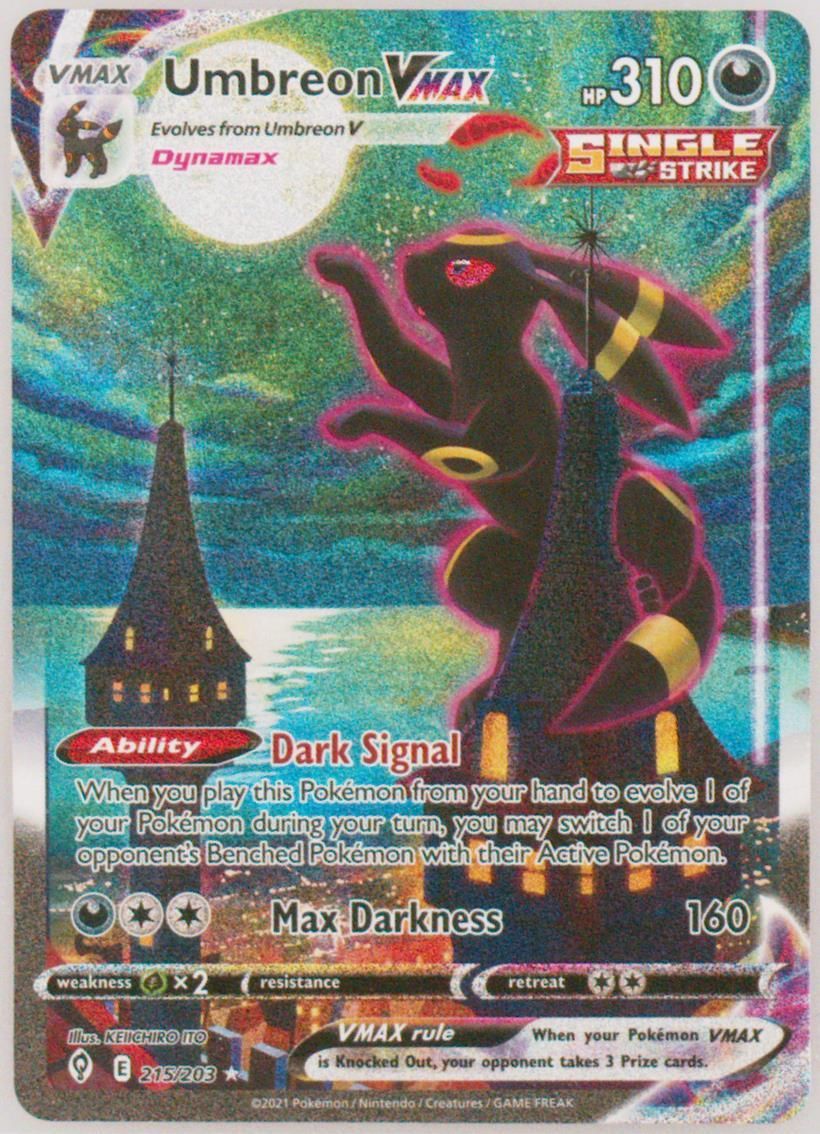
Try it yourself: Pull up the Umbreon VMAX Alt Art card page and look at the price chart. You'll see exactly how this card's graded values have shifted over the past year. Then compare it to the 151 Charizard SIR chart to see how two different chase cards can have completely different value trajectories.
Where Misprint tracking could improve:
- No dedicated portfolio feature (yet). You can track individual cards by visiting their pages, but there's no single dashboard that shows your entire collection's value change over time. We're working on this.
- Raw card data is thinner. For ungraded cards from recent sets, the price history is less robust than graded card data.
- Newer cards need time. A card released last week won't have meaningful trend data yet. It takes a few months of sales to establish a pattern worth analyzing.
Best for: Tracking graded card values over time with grade-specific granularity. Time range: Varies by card; established cards have years of data. Cost: Free.
2. PriceCharting — Best for Long-Term Historical Graphs
PriceCharting is the gold standard for deep historical price data. If you want to see how a card's price has changed over 5, 8, or even 10+ years, this is the tool.
What makes it stand out for tracking:
- Deepest historical data available. PriceCharting has been aggregating price data for years. Their charts go back further than any other Pokemon card pricing tool. For vintage cards especially, this historical depth is irreplaceable.
- Clean, readable graphs. The line charts are straightforward and show clear trends without clutter. You can quickly see whether a card is in a long-term uptrend, downtrend, or holding steady.
- Multi-source pricing. They aggregate from multiple marketplaces, which smooths out platform-specific anomalies. A temporary price spike on one marketplace doesn't skew the entire trend.
- Collection value tracking. You can add cards to your PriceCharting collection and see your total collection value change over time. This is one of the better implementations of portfolio tracking available.
- Price alerts. Set target prices for cards you're watching. PriceCharting will notify you when a card hits your target. Great for timing buys.
Where PriceCharting falls short:
- Weak graded card segmentation. PriceCharting tracks "graded" prices, but doesn't offer the granular grade-by-grade breakdown that Misprint provides. A PSA 10 and PSA 7 might be blended in some cases.
- Update lag. The charts update regularly but not in real-time. For rapidly moving prices, there's a delay between what's happening in the market and what the chart shows.
- Modern card data can be sparse early on. For brand-new sets, PriceCharting takes time to build sufficient data.
Best for: Long-term historical trend analysis, especially for vintage cards. Time range: Years to decades of data for established cards. Cost: Free basic access, premium membership for advanced features.
3. TCGPlayer — Decent Tracking for Raw Singles
TCGPlayer shows price history on every product page, making it a reasonable tracking tool for raw singles even though tracking isn't its primary function.
What it offers for tracking:
- Price history graph on every product page. Shows the Market Price trend over time. For popular raw singles, this gives you a clear picture of how the card's value has moved.
- Recent sales log. Below the graph, you can see individual recent sales with dates and prices. This lets you zoom into the most recent data and see exact transaction-level detail.
- Massive data set for modern cards. Because TCGPlayer handles so many raw single transactions, their price trend data for modern sets is comprehensive.
Where TCGPlayer falls short for tracking:
- No portfolio tracking. TCGPlayer doesn't let you build a collection and track its total value. You have to check each card individually.
- Graded card tracking is poor. The price history doesn't separate well by grade and grading company.
- No price alerts. You can't set a target price and get notified. You have to manually check.
- History depth is limited. TCGPlayer's visible history doesn't go back as far as PriceCharting for many cards.
Best for: Tracking raw single values from modern English sets. Time range: Several months to a couple years, depending on the card. Cost: Free.
4. PokeData — Portfolio Tracking With Analytics
PokeData has positioned itself as a data analytics platform for Pokemon card collectors and investors. Their portfolio features are among the more developed options available.
What it offers for tracking:
- Portfolio management. Add your cards and track your collection's total value over time. See gains, losses, and performance metrics.
- Market analytics. Beyond individual card tracking, PokeData provides broader market trend data that helps contextualize individual card movements.
- Price charts. Individual card price histories with decent granularity.
- Comparison tools. Compare multiple cards' price trajectories side by side. Useful for deciding between similar cards as investments.
Where PokeData falls short:
- Smaller data set. Fewer transactions informing the price data compared to TCGPlayer or eBay-sourced tools.
- Some features paywalled. The most useful analytics features often require a premium subscription.
- Less intuitive UI. The interface has a learning curve compared to simpler tools.
Best for: Collectors who want portfolio management with analytical depth. Time range: Good historical data for popular cards. Cost: Free basic, paid premium for full features.
5. Collectr — Best Mobile Collection Tracker
Collectr shines as a mobile-first collection management app that includes value tracking as a core feature.
What it offers for tracking:
- Collection management with value tracking. Add cards to your collection and see estimated values update automatically. Your total collection value is always visible.
- Quick scanning. Use your phone camera to add cards to your collection quickly. For more on scanning, see our scanner app comparison.
- Clean mobile interface. The app is well-designed and easy to navigate on a phone, which is where most people manage their collections casually.
- Set completion tracking. Beyond value, Collectr helps you track which cards you have from each set — useful for collectors who care about completion alongside value.
Where Collectr falls short:
- Price accuracy concerns. The pricing data isn't always as precise as Misprint, TCGPlayer, or eBay sold data. Estimates can feel generic.
- Limited historical depth. The price history charts don't go back as far as PriceCharting or Misprint.
- Graded card tracking is basic. Limited ability to differentiate between grades and grading companies.
Best for: Casual collection tracking on mobile with basic value monitoring. Time range: Limited historical data. Cost: Free with in-app purchases for premium features.
6. Manual Spreadsheet Tracking
This might sound old-school, but a surprising number of serious collectors still track card values in spreadsheets. And honestly? For certain use cases, it's hard to beat.
Why spreadsheets work:
- Complete customization. Track exactly what you want, how you want. Add columns for purchase price, current value, grade, notes, purchase date, target sell price — whatever matters to you.
- Cross-platform data. You can record prices from any source — Misprint, TCGPlayer, eBay, in-person purchases — in one place. No other tool aggregates your personal purchase data this way.
- Formulas for profit/loss. Simple formulas show you total collection value, profit/loss per card, ROI percentages, and more.
- Historical record. Once you record a price, it stays forever. You're not dependent on a platform maintaining its data.
Why spreadsheets don't work:
- Manual data entry is painful. Checking and recording prices for 50+ cards every week or month is tedious. Most people start strong and stop updating within a few months.
- No automation. Prices don't update themselves. You have to go check and enter them.
- No visualization without effort. Building charts in Google Sheets or Excel is possible but requires work.
- Easy to make errors. Typos in prices, forgetting to update certain cards, or inconsistent data entry all corrupt your data over time.
Best for: Serious collectors/investors who want complete control and don't mind the manual work. Time range: As long as you maintain it. Cost: Free (Google Sheets) to $10/month (Excel 365).**
Building a Tracking System That Actually Works
Most people don't need every tool. Here's how to build a practical tracking workflow based on what you collect:
If You Collect Graded Cards
Primary tool: Misprint. Bookmark the card pages for your most valuable graded cards and check the price charts monthly. The grade-specific data is exactly what you need.
Secondary tool: PriceCharting. Use this for the long-term view, especially for vintage graded cards. PriceCharting's deeper history helps you understand multi-year trends that Misprint's newer data set might not capture yet.
Supplement: PSA cert verification for population report monitoring. If you own low-pop graded cards, pop changes can affect value significantly.
If You Collect Raw Modern Cards
Primary tool: TCGPlayer. Their price history for modern raw singles is the most comprehensive.
Secondary tool: Collectr. For mobile collection management and basic value tracking across your whole collection.
Supplement: Misprint for any cards you're considering getting graded. Understanding the graded market before submitting cards helps you make smarter grading decisions.
If You're Building a Collection as an Investment
Primary tool: PriceCharting for long-term trend analysis and collection value tracking.
Secondary tool: Misprint for real-time market data and identifying current buying opportunities.
Supplement: A spreadsheet with your purchase prices, dates, and target sell prices. No app tracks your actual cost basis and profit/loss as accurately as your own records.
If You're a Casual Collector
Primary tool: Collectr on your phone. It's the easiest way to keep a running count of what your collection is roughly worth.
Supplement: Misprint or TCGPlayer when you want to check a specific card more carefully before buying or selling.
What to Actually Track (And How Often)
Tracking everything all the time leads to burnout. Here's a practical framework:
Weekly Check (5 minutes)
- Glance at your top 5-10 most valuable cards' current prices
- Note any significant moves (>10% in either direction)
Monthly Review (30 minutes)
- Check price charts for all tracked cards
- Update your spreadsheet if you maintain one
- Review total collection value
- Identify any cards trending down that you might want to sell
Quarterly Analysis (1-2 hours)
- Deep-dive into price trends across your collection
- Compare your collection's performance to broader market trends
- Decide on any rebalancing — selling underperformers, buying cards with upward momentum
- Review cards you're watching for potential purchase and check if they've hit your target price
After Major Events
- New set releases shift market dynamics. Track how your existing cards react.
- Tournament results can spike prices overnight. Check if anything you own got a boost.
- Reprint announcements tend to tank prices. React quickly if a card you own is getting reprinted.
- Check our card value identification guide to reassess cards that may have changed in desirability.
The Tracking Trap: When Obsessing Over Prices Ruins the Hobby
We need to say this because we see it constantly: checking your cards' prices every day is unhealthy for your enjoyment of collecting.
Cards fluctuate. A card worth $200 today might be worth $185 tomorrow and $210 next week. If you're checking daily, you experience every dip as a loss and every bump as a gain, even though the overall trend might be perfectly fine. This creates anxiety about a hobby that's supposed to be fun.
Track values to make informed decisions. Don't track values to drive yourself crazy. Monthly or bi-weekly is plenty for most collectors. Save the real-time monitoring for when you're actively looking to buy or sell.
Final Recommendations
Here's the summary:
| Tool | Best For | History Depth | Portfolio Feature | Cost |
|---|---|---|---|---|
| Misprint | Graded card price charts | Months to years | Coming soon | Free |
| PriceCharting | Long-term historical trends | Years to decades | Yes | Free/Premium |
| TCGPlayer | Raw singles price history | Months to years | No | Free |
| PokeData | Portfolio analytics | Good | Yes | Free/Premium |
| Collectr | Mobile collection tracking | Limited | Yes | Free/Premium |
| Spreadsheet | Custom tracking with cost basis | Unlimited (manual) | DIY | Free |
The "best" tool depends entirely on what you collect and how seriously you track values. But the real takeaway is this: track something. Even a basic monthly check on your most valuable cards gives you information that makes you a smarter collector.
Prices aren't static. Markets move. Cards appreciate and depreciate based on supply, demand, reprints, tournament results, and cultural moments. The collectors who track this data — even casually — consistently make better buying and selling decisions than those who check a price once and assume it's permanent.
Start with one tool. Bookmark your most valuable cards. Check them once a month. That alone puts you ahead of 90% of collectors who have no idea whether their Base Set Charizard is worth what it was when they last checked, or whether the market has moved $500 in either direction since then.
If you want to learn more about the fundamentals of how Pokemon card prices are determined, start with our pricing explainer. And if you're still building your collection and trying to figure out what's worth picking up, our guide on where to buy Pokemon cards online covers the best platforms for different types of purchases.