Are Mega Evolution Cards a Good Investment?
A young era, real grails, and a lot of unanswered questions. Here is the honest read.
By Misprint Editorial | Published Jun 16, 2026 | 6 min read
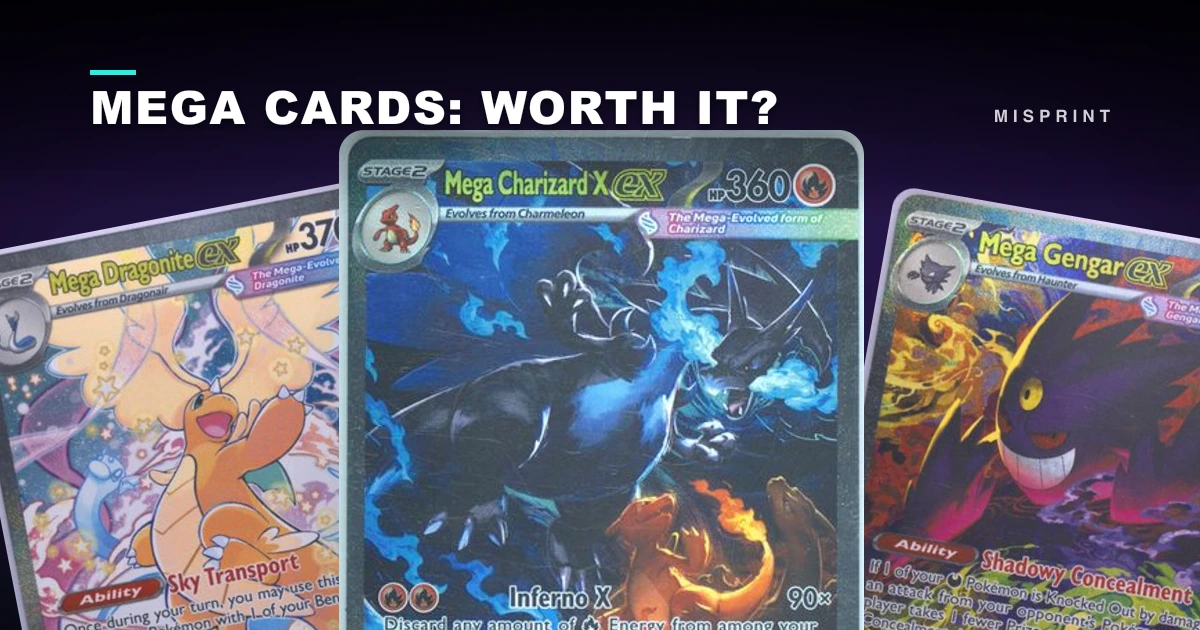
The Mega Evolution era has already minted a four-figure card. That is impressive for an era barely a year old, and it is also exactly the kind of fact that gets people to make decisions they regret.
The Mega Evolution era is the newest chapter of the Pokemon TCG, and like every new era it has arrived with a wave of hype, a fresh batch of chase cards, and a chorus of people asking whether they should be buying now. It is a fair question. The era has produced genuine grails, the Mega Gengar ex SIR among them, and the prices are real. But "real prices" and "good investment" are not the same thing, and the gap between them is where most collectors lose money.
This is our honest, no-hype analysis of whether Mega Evolution cards make sense as an investment in 2026. We do not give individual buy-or-sell advice, and we are not going to tell you a specific card is going to the moon. What we will do is lay out what the data shows, what the risks are, and how to think clearly about a market this young. If you need a primer on the cards themselves first, our explainer on what Mega Evolution ex cards are covers the mechanics and rarities.
The Case For: The Era Has Real Demand
Let us start with the bull case, because it is not nothing.
The Mega era has produced chase cards that rival the best of the prior era within months of launch. As of mid-2026, the top of the market looks like this, with all figures for raw near-mint copies and graded gem-mint selling for substantially more:
| Card | Set | Approx. raw value |
|---|---|---|
| Mega Gengar ex SIR | Ascended Heroes | ~$1,200 |
| Pikachu ex SIR (#276) | Ascended Heroes | ~$1,150, up 18% in June |
| Mega Charizard X ex SIR | Phantasmal Flames | ~$780 |
| Mega Dragonite ex SIR | Ascended Heroes | ~$750 |
| Mega Lucario ex Hyper Rare | Mega Evolution (base) | ~$280, down from a $720 launch peak |
That a single era produced this many high-hundreds-to-four-figures cards this fast tells you the demand is real. Our full most expensive Mega Evolution cards ranking goes deeper, but the pattern is what matters: the cards holding value are fan-favorite Pokemon in the best art treatments. Gengar, Charizard, Pikachu, Dragonite, Lucario. The Mega mechanic is the hook, but nostalgia is the engine, and that engine has driven Pokemon prices for decades.
The new gold Mega Hyper Rare tier also genuinely scarce. At roughly 1 in 540 packs, these are case hits, and scarcity plus iconic Pokemon is the oldest recipe in the hobby for a card that holds.
The Case Against: This Is a Very Young Market
Now the part the hype videos skip.
The single most important fact about the Mega era is that it is less than a year old. Every set is in or just past its print cycle. That has three consequences that should temper any investment thesis.
Supply is still landing. The thing that makes older sets appreciate, a one-way reduction in sealed supply after a set goes out of print, has not started for the Mega era. The Pokemon Company is still printing. Prices set today are being set against an unknown and growing supply, which is the opposite of the condition that drives appreciation.
Reprint risk is at its maximum. As we cover in our sealed product investment analysis, the biggest price jumps happen after a set is confirmed out of print with no reprint. Mega era sets are nowhere near that point. A popular set with demonstrated demand is exactly what the Pokemon Company reprints, and every reprint adds supply and pushes prices down.
Young-era prices are volatile. Launch hype inflates early prices, then they settle as supply catches up. We have watched this happen repeatedly across the era. The base set's Enhanced Booster Box traded at $250 to $300 against a $180 to $200 MSRP before normalizing. The Mega Gengar ex SIR cooled earlier in 2026 before climbing back above $1,100. Buying into a freshly launched card means buying at the most volatile and often highest point in its price history.
Singles vs Sealed: Different Bets Entirely
If you are going to treat Mega cards as an investment, it matters enormously whether you are buying singles or sealed product, because the two behave differently.
Singles are a bet on a specific card's demand outlasting its supply. The best candidates are the deepest-nostalgia, best-art cards, the Gengar and Charizard SIRs lead that pack on fundamentals. A graded gem-mint copy of one of these is the closest thing the era has to a blue-chip single. But you are paying a premium that already prices in a lot of demand, and the grading math has to work. Our guides on whether grading is worth it and which cards justify it are essential reading before you send anything off.
Sealed product is a bet on supply shrinking over years. For the Mega era, that bet is premature. None of these products are proven holds, and all of them carry high reprint risk. If you buy sealed, the deepest set (Ascended Heroes) and the era-first set (base Mega Evolution) have the strongest early cases, but "strongest early case" in a year-old era is a weak foundation for a financial decision. Buy sealed because you might open it and enjoy it, with appreciation as an upside, not a plan.
What History Suggests
We do not have a Mega era track record yet, but we have decades of prior eras, and the lesson is consistent. The cards that held value across Evolving Skies, 151, and Prismatic Evolutions were the iconic-Pokemon-plus-best-art chase cards. The standard and full-art versions of those same Pokemon were a fraction of the price and stayed there. The Mega era is rhyming with that pattern exactly, which is reassuring for the top cards and a warning for everything else.
It is also worth remembering that the broader market moves in cycles. The hobby surged in 2020 and 2021, corrected, and has been selectively recovering since. A Mega card bought today is exposed to whatever the macro market does next, regardless of how good the individual card is. Our mid-2026 market read covers where the broader market sits right now.
So, Are They a Good Investment?
Here is our honest framework.
If you are buying the top-tier singles (Gengar SIR, Charizard SIR) in graded gem-mint condition, holding for years, and you genuinely want to own them, the fundamentals are as good as anything the era offers. These are the cards with the deepest nostalgia and the strongest art, and they have the best case to hold. But understand you are buying near the top of a young, volatile market, not near the bottom of a proven one.
If you are buying mid-tier or standard Megas hoping they appreciate, the odds are against you. Set value concentrates in a handful of cards, and the rest tends to drift toward bulk.
If you are buying sealed product as a pure investment, wait. The era is too young, supply is still landing, and reprint risk is at its peak. The condition that drives sealed appreciation, confirmed out-of-print status, is years away for these sets.
And if you are buying because you love the cards and the appreciation would just be a bonus, then the math matters far less, and you have probably already made the right decision for the right reason.
The Bottom Line
Mega Evolution cards are not a bad investment, but the honest answer is more boring than the hype videos want it to be. The era has produced legitimate grails with real demand, and the top singles have the strongest fundamentals the era offers. But it is a very young market, prices are volatile, supply is still landing, and reprint risk is at its highest. That combination argues for patience and selectivity, not for backing up the truck.
Buy the iconic cards you would be happy to own regardless of price. Treat sealed product as entertainment with upside, not as a sure thing. And remember the oldest rule in the hobby: the best time to evaluate an investment is after the hype has settled, not while it is still landing on shelves. We will keep tracking the era's prices and update our read as the data matures.