Mega Charizard X ex: Price History and Variants
The era-defining Charizard, tracked from launch hype to its mid-2026 trading range.
By Misprint Editorial | Published Jun 19, 2026 | 6 min read
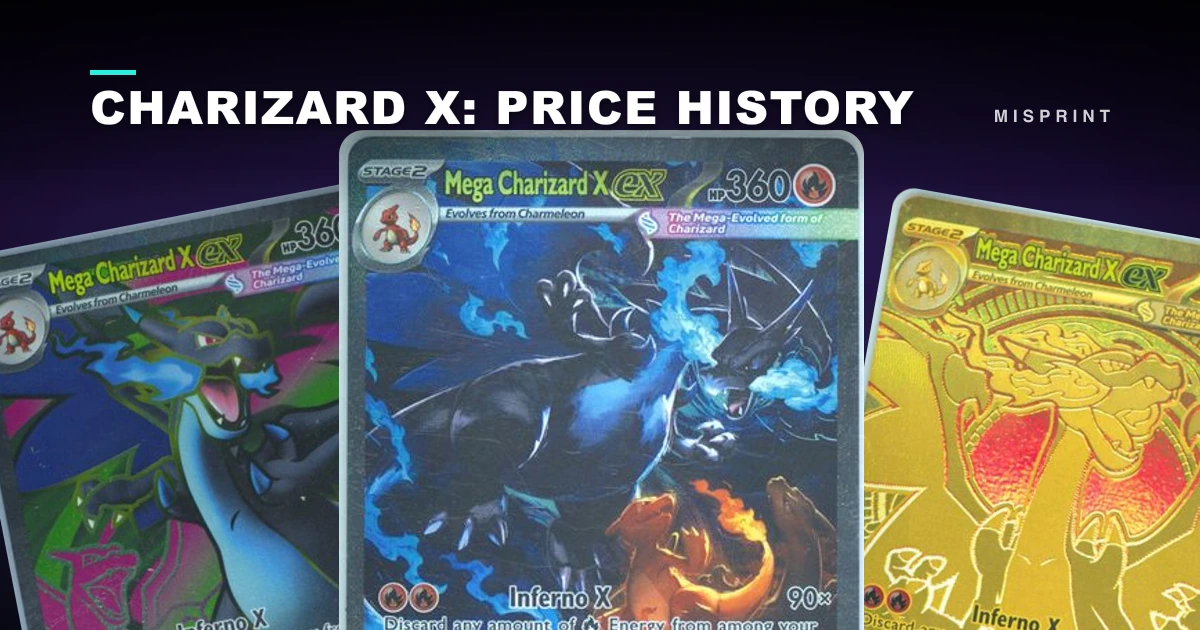
Charizard always sets the ceiling. Tracking how Mega Charizard X ex got there, and where it settled, is the cleanest way to read the entire Mega Evolution era.
When the Mega Evolution era needed its first obvious grail, it got one: Mega Charizard X ex, the headline card of Phantasmal Flames. It checks three collector boxes at once, Charizard, the black-and-blue X mega form, and the premium Special Illustration Rare treatment, and the market priced it accordingly from day one.
This is a price history. We are tracking how the card has moved from its early launch period through mid-2026, across its main variants, in both raw and graded form. As always, Pokemon prices are volatile, especially for a card this visible and this young, so treat every figure here as a point-in-time read rather than a fixed value. For the broader set context, our Phantasmal Flames chase card guide covers the rest of the lineup.
The Variants You Are Actually Pricing
There is no single Mega Charizard X ex price, because there is no single Mega Charizard X ex card. The name covers several variants at very different price points, and conflating them is the most common mistake new buyers make.
| Variant | Rarity | Approx. raw value (mid-2026) |
|---|---|---|
| Mega Charizard X ex (#125) | Special Illustration Rare | $676.72 |
| Mega Charizard X ex | Mega Hyper Rare (gold) | $202.02 |
| Mega Charizard X ex | Ultra Rare / Full Art | $59.26 |
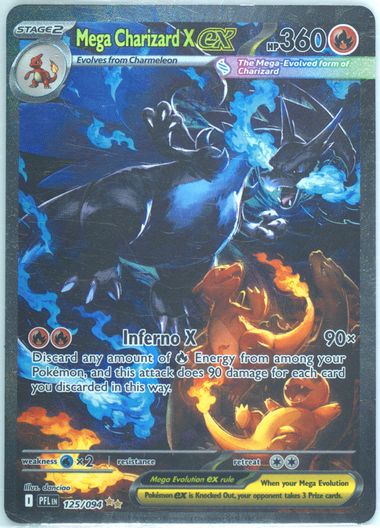
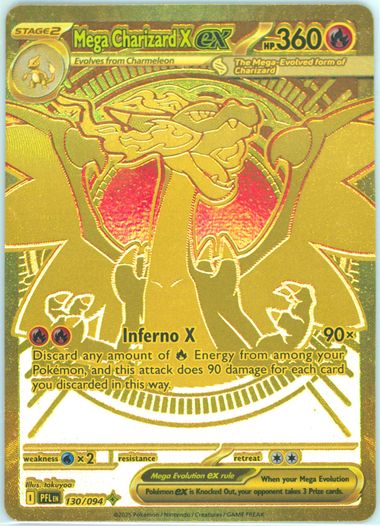
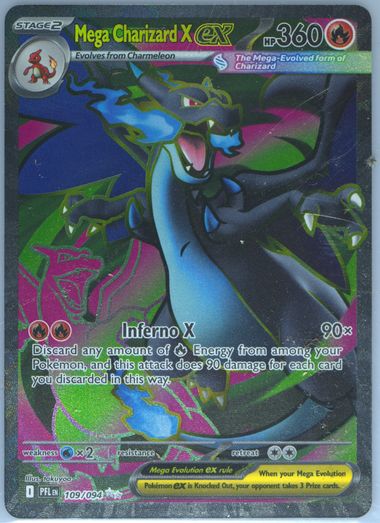
These figures are Misprint's internal raw near-mint read as of mid-2026; external trackers run somewhat higher, with the TCGplayer market price for the SIR around $780 in mid-June. The SIR (#125) is the card the market means when it talks about "the Charizard," and it is the one with the deepest price history. The gold Mega Hyper Rare is the scarcest variant, but it trades well below the SIR because the SIR is the iconic illustration collectors anchor to. The Ultra Rare full art is the affordable entry point and the version most casual collectors actually end up owning.
The SIR Price History
The Special Illustration Rare (#125) is where the real story is, and its trajectory is a textbook modern-Charizard arc: a high launch, a correction as supply opened, and then a firmer trading range.
In graded gem-mint form, the card peaked early. Verified PSA 10 data from late 2025 shows copies trading as high as the mid-$2,000s, with figures near $2,750 cited shortly after release, classic launch-hype pricing when graded supply is thinnest. By late January 2026, PSA 10 sales had settled into a roughly $1,800 to $2,025 band, with a sale around $2,025 and earlier December 2025 sales near $1,798 marking the new range.
By mid-2026, external trackers put PSA 10 copies in the low-to-mid $2,000s again (figures around $2,318 have been reported), suggesting the card found a floor and recovered some ground rather than continuing to slide. Misprint's internal snapshot reads the graded market in the same neighborhood, with PSA 10 around $2,186.70.
| Grade tier | Misprint internal read (mid-2026) |
|---|---|
| Raw near-mint | $676.72 |
| PSA 9 | $840.97 |
| PSA 10 | $2,186.70 |
The headline takeaway is the size of the grade spread. A raw copy sits around $677, a PSA 9 around $841, and a PSA 10 above $2,100. That is an enormous gap, and it is the single most important fact for anyone deciding whether to buy raw and grade, buy a PSA 9, or pay up for a gem-mint copy.
What the Grade Spread Means for Buyers
A spread this wide changes the strategy. On most modern singles, the gap between raw and PSA 10 is modest enough that the decision is mostly about convenience. Here, it is the whole decision.
The raw-and-grade math: if you buy a raw copy near the current $675 to $700 market, then pay grading, shipping, insurance, and eventual marketplace fees, you need a strong PSA 10 outcome to justify the risk. A PSA 9 around $841 can leave you close to breakeven once every cost is counted, and not every raw card grades a 10. Centering, surface lines, whitening, and print texture all matter on a card this scrutinized.
That makes condition assessment the entire game. A raw card photographed in a sleeve and top loader is not enough information for a four-figure graded bet. If you want certainty and liquidity instead of grading risk, buying a PSA 10 outright is the more disciplined play, you pay for the grade, but the grade is already locked. Our PSA vs CGC resale guide and our is grading worth it framework both apply directly to this card.
Why It Has Held Better Than Most
One of the more notable things about Mega Charizard X ex is that it has held its value better than most chase cards of its era. Plenty of Mega-era singles softened through the first half of 2026 as supply opened and attention rotated to newer sets. The Charizard SIR did correct from its launch peak, but it settled into a stable range rather than sliding indefinitely.
The reason is the same one that has distorted Charizard economics for decades. The market does not price Charizard like a normal Pokemon with normal supply and normal demand. It prices Charizard as a brand within the brand. Combine that with the first major Mega-era Charizard chase card and the premium SIR treatment, and you get a card with a thesis casual buyers and serious investors both understand instantly. That shared understanding is what creates a floor. We ranked it among the era's most valuable cards in our most expensive Mega Evolution cards breakdown, and it sits comfortably with the era's other most expensive Charizard cards.
The Gold and Full-Art Variants
The non-SIR variants tell their own price stories.
The Mega Hyper Rare (gold) version sits around $202.02 raw in our data. It is scarcer than the SIR, but scarcity alone does not make it more valuable, because the SIR is the illustration collectors actually want. The gold card is a strong secondary target, especially for completionists, but it is not the variant carrying the set.
The Ultra Rare full art sits around $59.26 raw and is the realistic entry point. For a collector who wants a Mega Charizard X ex on the wall or in the binder without spending several hundred dollars, this is the version that makes sense. It is also the variant least exposed to the grade-spread risk that defines the SIR.
What We Would Watch Next
Three things matter for the rest of 2026.
First, watch graded population growth. PSA 10 supply has been expanding (population figures north of 230 have been reported and climbing), and a faster-growing population can compress the gem-mint premium over time. If gem rates stay tough, clean raw copies become more attractive as grading candidates.
Second, watch raw price stability. New-release and post-release prices often soften before they stabilize. The SIR has held its range so far, but Phantasmal Flames is still in print, and continued supply or a reprint could pressure raw copies lower.
Third, watch the Charizard calendar. The market can support multiple Charizard grails, but attention is not infinite. A stronger later Mega Charizard card could cap the upside here, while a quiet Charizard stretch would help this card age better. For where the broader market sits, see our mid-2026 market analysis.
The Bottom Line
Mega Charizard X ex is the cleanest single-card read on the entire Mega Evolution era. The SIR launched hot, corrected, and settled into a firm range around $677 raw and the low-to-mid $2,000s for a PSA 10, holding better than most of its peers because Charizard demand provides a floor that newer chase cards lack.
If you want the card, the first decision is variant, then condition. The SIR is the grail and the one with the wide grade spread that rewards careful buying. The gold Mega Hyper Rare is the scarce completionist piece. The full art is the affordable entry. Whichever you choose, do the fee math before you assume any raw copy is an easy flip, because on this card, the grade is most of the value.