Magic's Reserved List, Explained
The promise never to reprint 572 cards, and why it made them so valuable.
By Misprint Editorial | Published Feb 16, 2026 | 6 min read
The promise never to reprint 572 cards, and why it made them so valuable.
Almost every high price in vintage Magic traces back to a single policy document. The dual lands that cost more than a booster box each, the utility lands that anchor Commander decks, the artifacts that define Vintage and Legacy: most of them are expensive not because they are the best cards ever printed, but because Wizards of the Coast has promised, in writing, never to print them again. That promise is the Reserved List, and it is the most consequential business decision in the history of the game's secondary market.
What the Reserved List actually is
The Reserved List is a fixed roster of 572 cards that Wizards has committed to never reprint in a functionally identical, tournament-legal form. Every card on it was originally printed no later than June 1999 (Urza's Destiny was the last set to add cards to it), and the list has been closed for years: no cards are added and none are removed.
The key phrase is "functionally identical." Wizards defines that narrowly. A reprint is only barred if the new card shares the same card type, subtypes, abilities, mana cost, power, and toughness as the original. That is why you occasionally see a modern card that does almost the same thing as a Reserved List staple but with a tweaked mana cost or a slightly different ability. The design has to be legally distinct to sidestep the promise.
One important carve-out: the policy applies only to physical, tournament-legal cards. Digital versions on Magic Online and MTG Arena are fair game, which is why you can play a Black Lotus online for pennies while a paper copy costs the price of a used car.
Why Wizards created it
The Reserved List was a response to a genuine crisis of trust in 1995. That April, Wizards released Fourth Edition, and in July it released Chronicles. Together those two sets reprinted close to 500 cards drawn from Alpha, Beta, and the earliest expansions. Chronicles in particular flooded the market with white-bordered copies of previously scarce cards from Arabian Nights, Antiquities, Legends, and The Dark.
Collectors were furious. Cards they had paid a premium for cratered in value almost overnight. The reprints carried white borders and were cosmetically distinct, but that did nothing to protect the original printings' prices. Facing a revolt from the exact enthusiasts who were propping up the early game, Wizards published its Official Reprint Policy on March 4, 1996, with the Reserved List at its center. The message to collectors was simple: buy these cards and their scarcity is guaranteed forever.
The "foil loophole" and how it closed
The policy was not static. A 2002 revision opened what became known as the foil loophole: it allowed Reserved List cards to be reprinted as long as they appeared only in premium (foil) form. Wizards used that opening more than once. Phyrexian Negator showed up in the Duel Decks: Phyrexia vs. the Coalition set. From the Vault: Relics included foil versions of Karn, Silver Golem, Masticore, Memory Jar, and Mox Diamond. Cards like Wheel of Fortune, Morphling, Phyrexian Dreadnought, and Thawing Glaciers went out as judge promos.
Collectors pushed back again. Mark Rosewater has said these foil reprints upset the silent majority of the player base, and in 2010 Wizards revised the policy a final time, eliminating the premium exception entirely. Since that revision, no Reserved List card can be reprinted in any tournament-legal form, foil or not. That version still governs the list today, and it is a large part of why prices on these cards have climbed so relentlessly since.
How the list props up values
The mechanism is straightforward supply economics. For a normal Magic card, strong demand eventually triggers a reprint. When a Commander staple spikes, Wizards can slot it into a Masters set, a Commander deck, or a Secret Lair, and the price comes back down. Reserved List cards have no such release valve. Demand can only chase a supply that is fixed forever and, thanks to loss, damage, and grading, slowly shrinking.
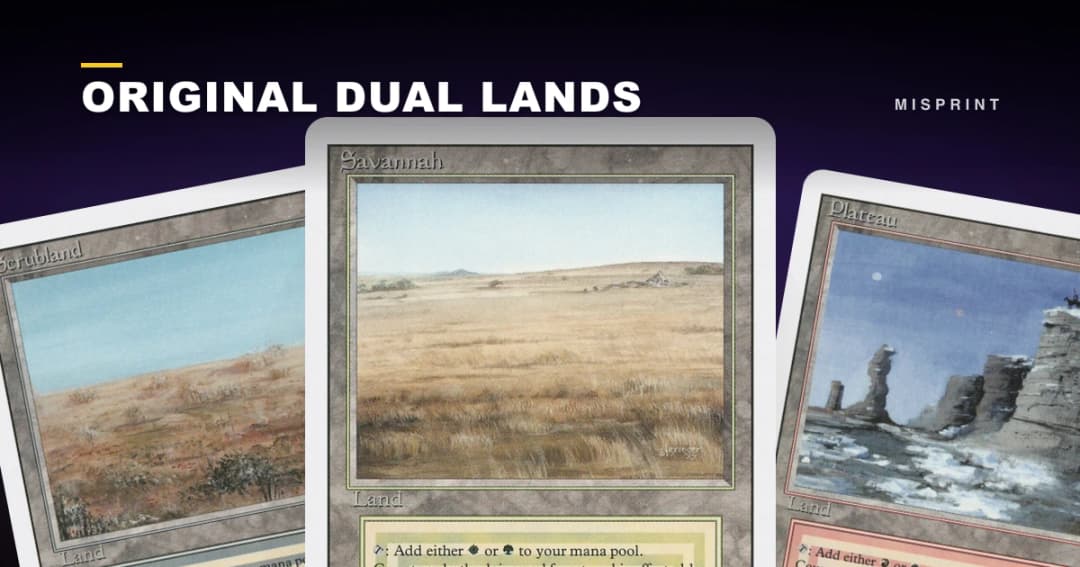
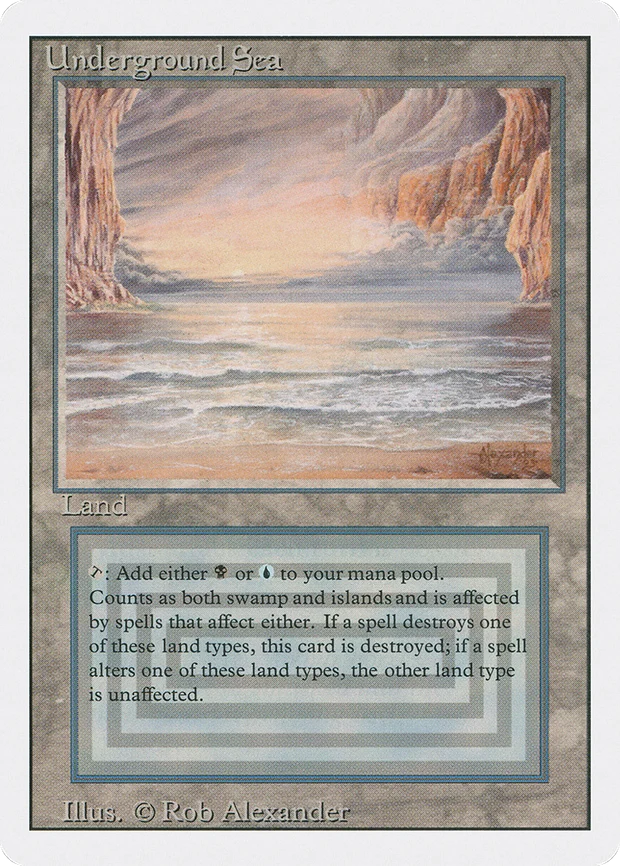
That is why the original dual lands (Underground Sea, Volcanic Island, Tropical Island, Tundra and the rest of the ten-card cycle) behave more like scarce collectibles than like game pieces. Revised copies of the strongest duals trade in the high hundreds to low thousands of dollars each. Underground Sea carried a market price around $979 in mid-2026, and Volcanic Island sat near $862, with both spanning a wide $685 to $1,100 range depending on condition and source. Those are not the numbers of a card printed by the millions. They are the numbers of a card that will never be printed again.
If you want the deeper history of that cycle, our collector's guide to the original dual lands breaks down each printing and what drives the spread.
Notable cards on the list
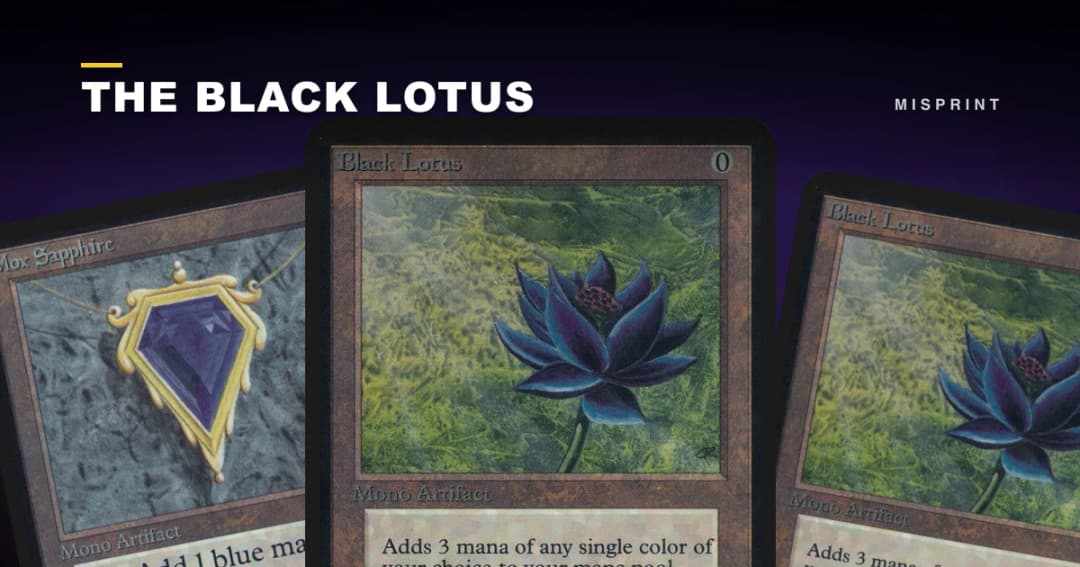
The list is a who's-who of expensive Magic. The Power Nine, including the Black Lotus, are all reserved, which is why a pristine Alpha Black Lotus sold for a record $3 million in 2024 and why even a played Unlimited copy runs into the thousands.
Beyond the marquee power, the list protects a set of format-defining lands and artifacts:
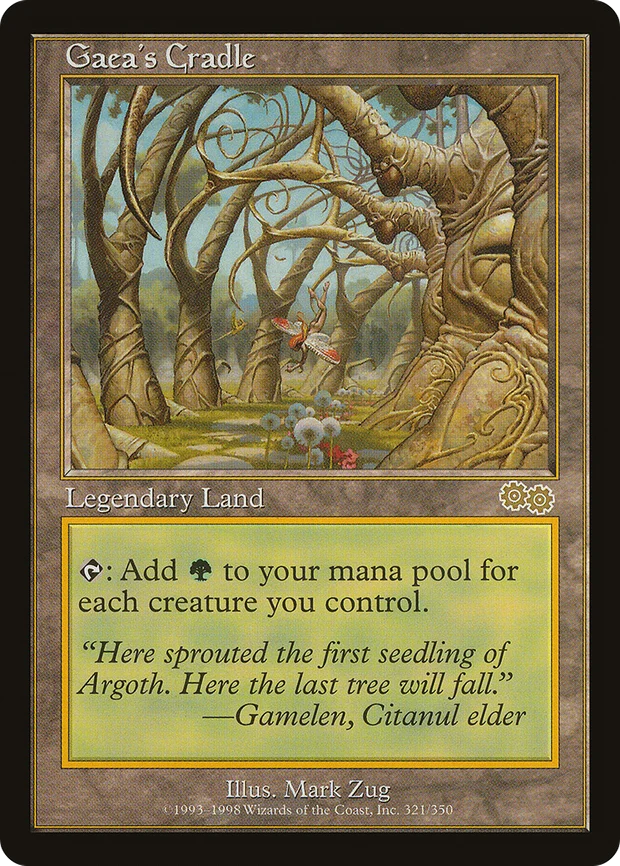
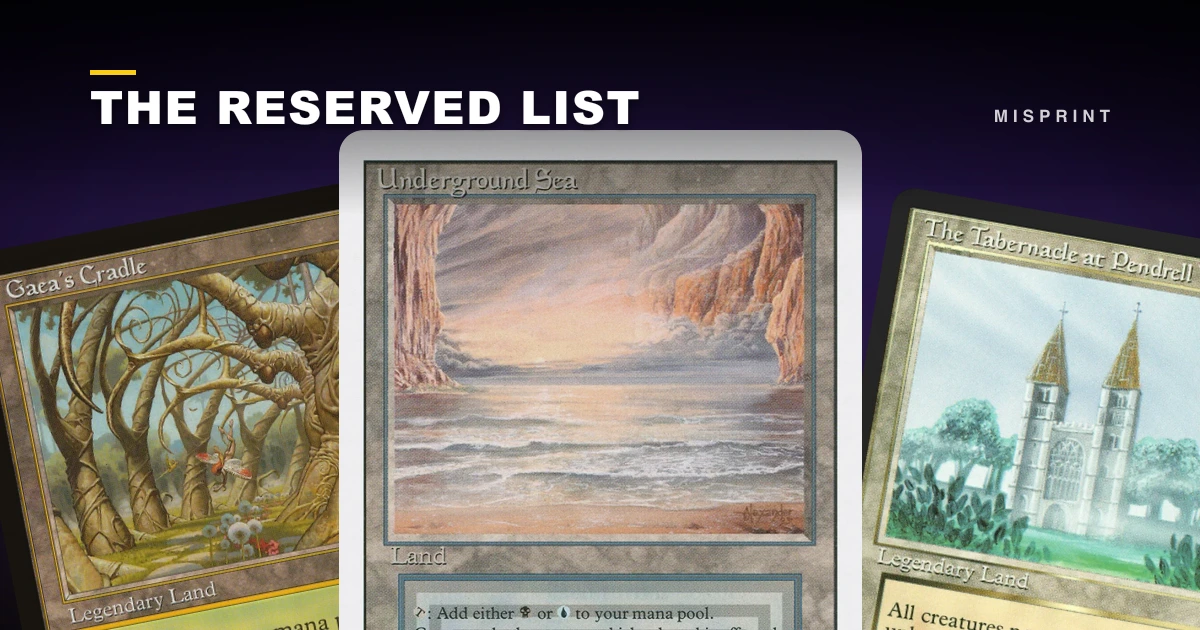
Gaea's Cradle (Urza's Saga) is one of the most sought-after lands in Commander, generating green mana equal to your creature count. It has traded around $1,579 in mid-2026.
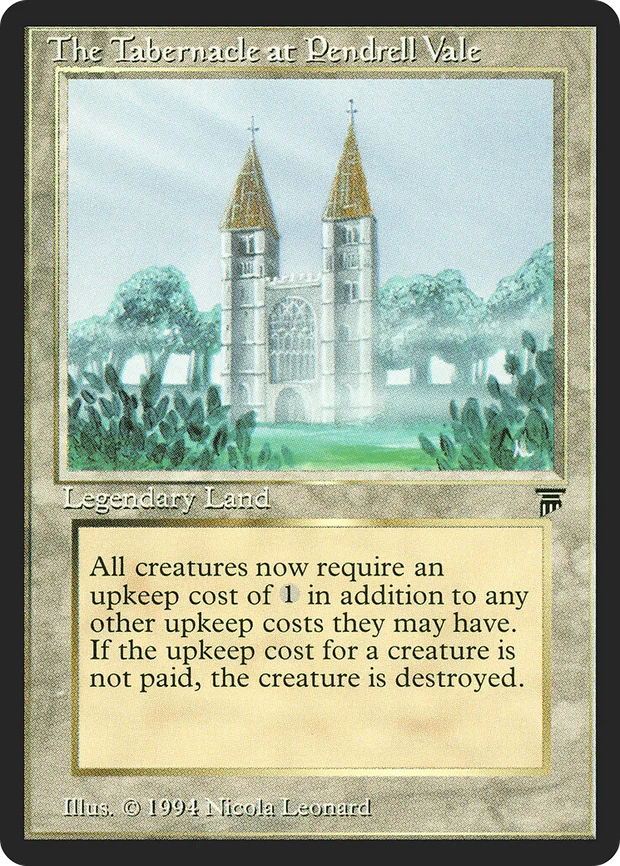
The Tabernacle at Pendrell Vale (Legends) is arguably the most valuable non-power land in the game, taxing every creature on the board. Prices have ranged from about $2,900 to $4,000 depending on the tracker.
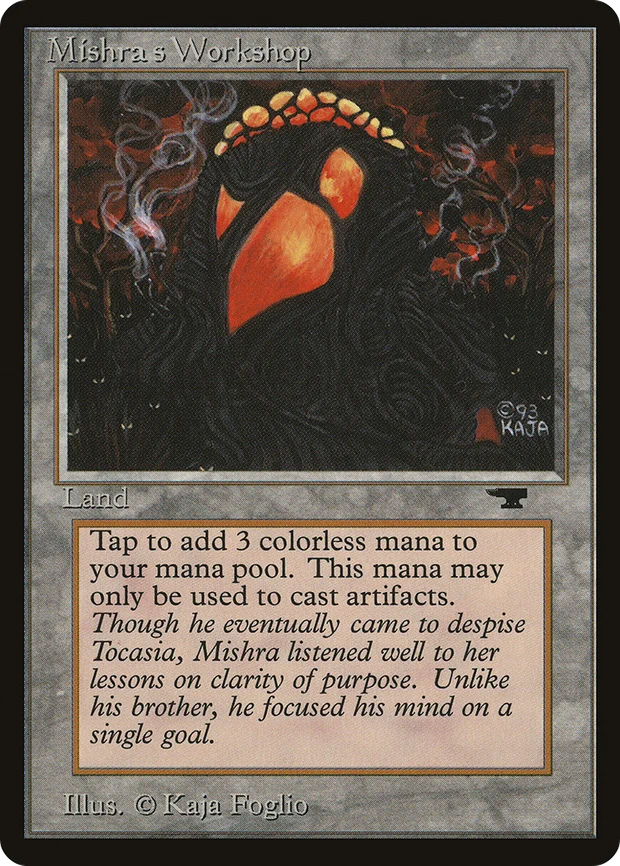
Mishra's Workshop (Antiquities) powers explosive artifact starts in Vintage and lists around $3,000 to $3,400 for original copies.
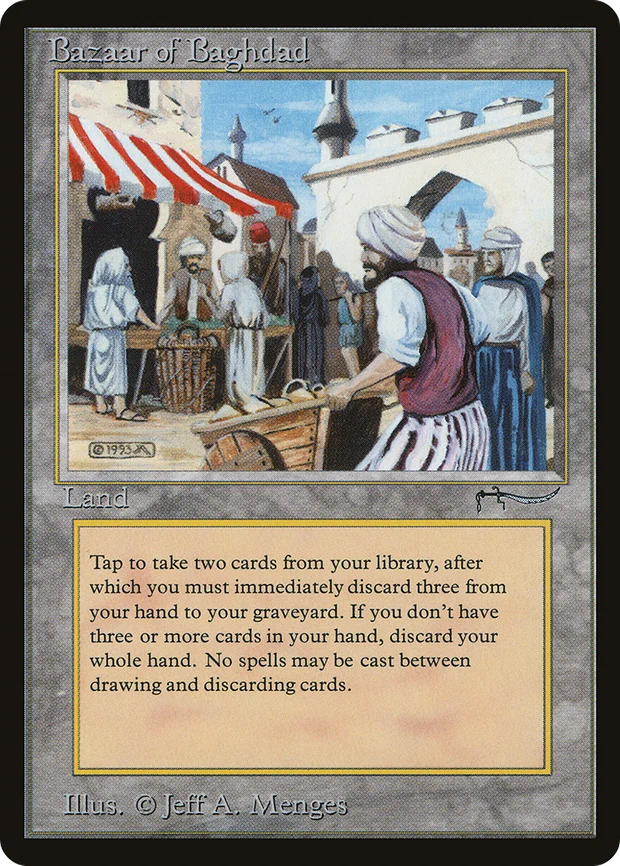
Bazaar of Baghdad (Arabian Nights) is the engine behind Vintage Dredge, and its tiny original print run keeps it near $1,950. Other heavy hitters include Mana Drain, Lion's Eye Diamond (around $820), Grim Monolith, Serra's Sanctum, and Metalworker.
| Card | Set | Approx. mid-2026 price |
|---|---|---|
| Underground Sea | Revised | $979 |
| Gaea's Cradle | Urza's Saga | $1,579 |
| Bazaar of Baghdad | Arabian Nights | $1,950 |
| Mishra's Workshop | Antiquities | $3,000 to $3,400 |
| The Tabernacle at Pendrell Vale | Legends | $2,900 to $4,000 |
| Lion's Eye Diamond | Mirage | $820 |
What it means for collectors and investors
The Reserved List is the closest thing Magic has to a guarantee, and that guarantee is exactly what makes these cards a favorite topic in the is-Magic-a-good-investment conversation. Fixed supply plus steady demand has been a durable recipe, and Reserved List cards feature heavily in most rankings of the best Magic cards to invest in for 2026.
Two cautions are worth keeping in mind. First, the list is a corporate policy, not a law. Wizards has reaffirmed it repeatedly and treats it as untouchable, but there is always a nonzero risk that a future management decides otherwise. Second, the prices quoted above come from aggregators and price trackers, which often run ahead of what cards actually sell for; real completed-sale numbers move constantly and can lag the headline figure. Tools that track graded-market data, Misprint among them, are useful precisely because condition and recent sold prices matter enormously on cards this expensive. Treat any single listed price as a starting point, not gospel, and verify against recent sales before you buy or sell.