Magic: The Gathering Market Report (2026)
Record revenue, release fatigue, and a market splitting into two very different halves.
By Misprint Editorial | Published Jul 1, 2026 | 6 min read
Record revenue, release fatigue, and a market splitting into two very different halves.
Magic: The Gathering has never made more money, and its players have never argued more about the cost of that success. Both things are true in 2026, and they explain most of what is happening in the market this year. Hasbro's Wizards of the Coast segment posted its strongest year on record in fiscal 2025, with Magic revenue climbing to $1.72 billion, up roughly 59 percent year over year and accounting for the lion's share of Wizards' contribution to Hasbro's $4.7 billion in total revenue. The engine behind that number was a single crossover set. The consequence is a 2026 release calendar that has reshaped how collectors think about buying, holding, and selling.
Here is the honest summary before the detail: the top of the market (vintage, Reserved List, graded staples) is calm and firm, the sealed Collector Booster market corrected hard off its 2025 presale highs, and the release schedule is running hot enough that "fatigue" has gone from a forum complaint to something Wizards now addresses on stage. Let's walk through each.
Final Fantasy broke the revenue model, then the sealed market
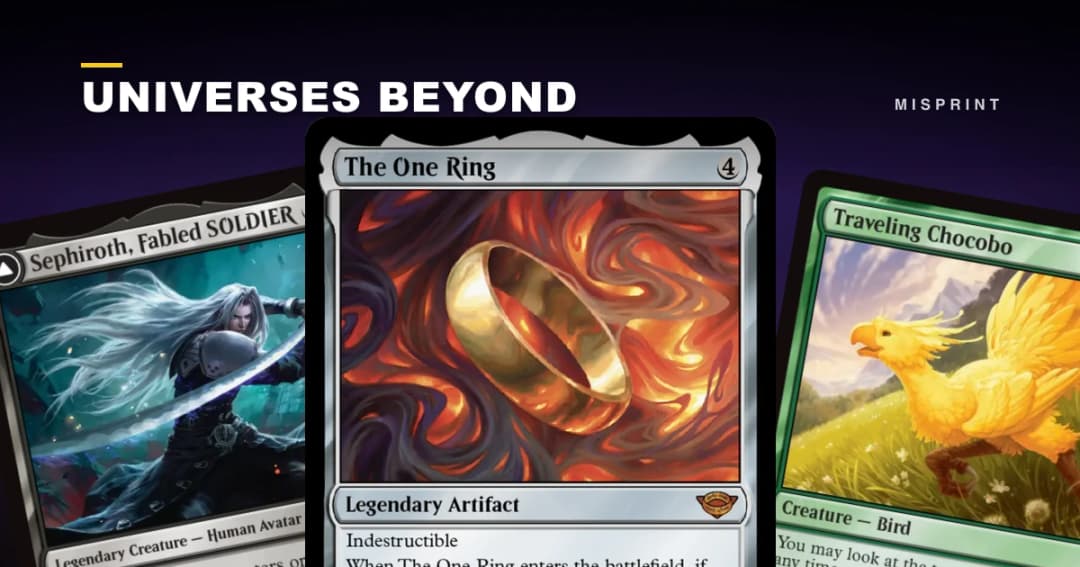
The 2025 story that everything in 2026 rests on is Universes Beyond: Final Fantasy. It became the best-selling Magic set of all time, and it did so almost instantly. Hasbro's leadership put it plainly: The Lord of the Rings: Tales of Middle-earth took about six months to deliver $200 million in revenue, and Final Fantasy did the same in a single day. Presales alone were enough to crown it. Wizards increased the print run several times over any prior set and still left the market short.
That kind of demand pulled a wave of new, non-traditional buyers into sealed product, above all the Final Fantasy Collector Booster Box, which traded past $1,000 on the secondary market on the strength of its serialized chase cards. When that speculative capital moved on, the whole Collector Booster category cooled from its presale highs. The clearest evidence came from the sets that followed. Collector Booster boxes for the Spider-Man and Avatar: The Last Airbender crossovers were bid toward $1,000 in presale, then settled back to roughly $750 and $525 respectively once product actually hit shelves. That is still well above the roughly $450 the 12 packs cost at retail, but it is a punishing round trip for anyone who bought at the presale peak, and it is the single most important cautionary tale in the 2026 market.
The lesson tracks with what we have written before about booster boxes versus singles as investments: sealed hype prices are set by presale speculation, not by what the product is worth once everyone can open one. The correction did not hit everything equally, though. Play Boosters and genuinely playable competitive singles held up well, because that demand comes from people using the cards rather than flipping the box.
The chase cards are real, and they are volatile
Universes Beyond keeps minting genuine chase cards, and Final Fantasy's Sephiroth, Fabled SOLDIER is the poster child. The borderless surge foil printing has traded in the $800 to $1,050 range on the major aggregators, while the standard non-foil sits under $10. That spread is the entire modern-treatment economy in one card: the game piece is cheap, the cosmetic is expensive, and the cosmetic price is the part that moves. If you are buying these as investments rather than because you want them in a deck, understand that you are speculating on a foil treatment's popularity, which is a far shakier bet than a format staple. Our Universes Beyond explainer covers how these crossovers are structured and why the collector-facing versions carry the premium.
A caveat that applies to every number in this report: aggregator prices (TCGplayer market, MTGStocks, PriceCharting) can run ahead of what cards actually sell for, especially on thinly traded modern chase cards where a handful of listings set the tone. Treat them as a directional guide, not a quote. Tools like Misprint's graded-market tracking exist precisely because "listed" and "sold" can drift apart on high-end cards.
Release fatigue is now an official topic
In 2026, Magic is releasing seven sets, four of them Universes Beyond and only three in-universe. It is the first year where crossovers outnumber original Magic worlds. The in-universe sets are Lorwyn Eclipsed (which opened the year on January 23), Secrets of Strixhaven (April 24), and Reality Fracture (October 2). The Universes Beyond slate runs Teenage Mutant Ninja Turtles (March 6), Marvel Super Heroes (June 26), The Hobbit (August 14), and Star Trek (November 13).
That is a lot, and Wizards knows it. Head designer Mark Rosewater has publicly called 2026 "an outlier" and said future years will settle back to "three and three," meaning three in-universe and three Universes Beyond sets rather than seven total. Wizards has also argued that fatigue is loudest online and quieter in actual game stores. Both framings can be true. What matters for collectors is the practical effect: more products chasing the same wallets compresses the window in which any single set stays "the new thing," which accelerates how fast non-staple cards fall off after release. If you collect for value, the schedule is an argument for patience. Prices for most cards from a hyped set are lower three months out than they are at launch.
For a deeper look at how these crossovers reshaped the collectible side of the game, see our piece on how Universes Beyond changed Magic's market.
Vintage is the quiet, stable half of the market
While new product whipsaws, the old cards barely flinched. The Reserved List, Wizards' 30-year promise never to reprint a specific set of older cards, remains the most credible no-reprint guarantee in trading cards, and it continues to anchor the high end. A gem-mint Alpha Black Lotus sits at the very top of the pyramid; the record sale is a PSA 10 at $540,000. PSA 10 Beta copies are a tier below, trading in the neighborhood of $150,000 to $200,000, and Unlimited copies well under that, with PSA 10 Unlimited in the $30,000 to $60,000 range. The actively traded Reserved List cards, above all the original dual lands like Underground Sea, Volcanic Island, and Tropical Island, have shown steady appreciation. Played Revised-edition copies run from a few hundred dollars up to around $1,000 for Underground Sea, the priciest of the cycle, while Alpha, Beta, and graded copies climb well into the thousands.
None of that is exciting, and that is the point. Post-pandemic, high-grade Power Nine and Reserved List material has behaved like a store of value rather than a lottery ticket, which is exactly why it draws the highest-dollar buyers. If you want the full picture on why these cards do not get reprinted away, our Reserved List explainer is the place to start, and the dual lands value guide breaks down the cycle card by card.
What to actually watch for the rest of 2026
Three signals are worth tracking. First, whether Collector Booster boxes settle at a stable price now that speculative buyers have largely exited, or keep drifting back toward the roughly $450 retail cost of the packs inside. Second, whether Marvel Super Heroes and Star Trek match Final Fantasy's broad crossover demand or track Spider-Man and Avatar, which corrected off their presale highs but still held well above retail. Third, whether Rosewater's promised return to a lighter six-set schedule in 2027 actually shows up, because that alone would ease the fatigue conversation.
The through-line for collectors is the same one that has held for years. Cards that people play hold value better than cards people only speculate on, and the oldest, scarcest cards remain the steadiest ground in the entire market. If you are thinking about where to put money rather than just what to enjoy, our guide to the best Magic cards to invest in for 2026 and our breakdown of which Magic sets hold their value best both lean on exactly that logic.
Prices in this report are drawn from public aggregators and reflect a moving market. Listed prices can sit above actual sold prices, especially on high-end and low-liquidity cards, so verify recent sales before buying or selling.