How Universes Beyond Changed Magic's Collectible Market
The Walking Dead broke it open. Final Fantasy blew the doors off.
By Misprint Editorial | Published Jun 29, 2026 | 6 min read
The Walking Dead broke it open. Final Fantasy blew the doors off.
For most of Magic's history, the game lived inside its own fiction. Planeswalkers, mana, invented worlds like Dominaria and Ravnica. Then in October 2020, Wizards of the Coast dropped a Secret Lair featuring characters from AMC's The Walking Dead, and something broke open. Rick Grimes and Negan, rendered as mechanically unique cards, legal in Eternal formats. Fans were furious. The drop sold better than anything Secret Lair had done before. That tension between outrage and record sales has defined every year since, because the Walking Dead drop became the seed of what Wizards now calls Universes Beyond, the branch of Magic that licenses outside intellectual property and prints it on real cards.
Six years later, Universes Beyond is not a novelty. It is arguably the most important commercial force in the game, and it has rewired how collectors think about value, scarcity, and what a "chase card" even is. Here is how it happened and what it did to the market. For the mechanics of how these products are structured, see Universes Beyond, Explained.
From experiment to flagship
After the Walking Dead reaction, Wizards leaned in rather than retreating. Warhammer 40,000 and Doctor Who arrived as full Commander products. Then in June 2023 came the release that changed the argument entirely: The Lord of the Rings: Tales of Middle-earth. It was a complete, draftable set, not a side product, and it landed like a comet. Hasbro disclosed that the set generated more than $200 million in revenue, and it went on to become the best-selling Magic release ever, a title it held until Final Fantasy.
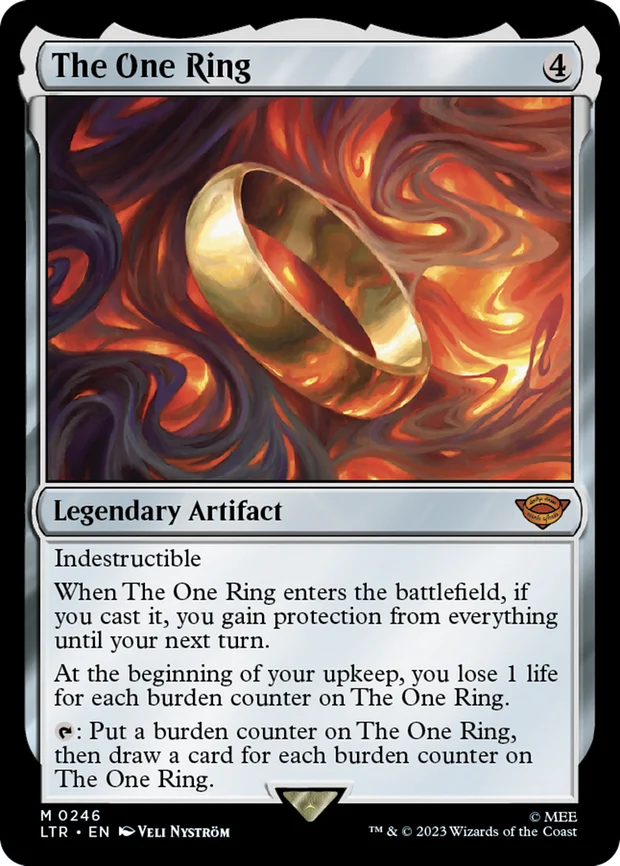
Tales of Middle-earth also produced the single most famous card in the game's collecting history. Wizards seeded exactly one copy of a special serialized version of The One Ring, stamped 001/001, its text printed in the Black Speech of Sauron using Tengwar letterforms. Musician and noted Magic collector Post Malone bought it in a private deal reported at $2 million, the highest price ever paid for a single Magic card. The regular version of The One Ring is a different story and a useful reality check: it is a genuinely good card that saw heavy play, and in mid-2026 the normal print trades around $100 to $105, with the standard foil near $130 according to aggregator data. For a full breakdown of that set's chase cards, see The Most Valuable Cards from The Lord of the Rings: Tales of Middle-earth.
Final Fantasy rewrote the ceiling
If Lord of the Rings proved the model, Magic: The Gathering Final Fantasy (June 2025) proved there was almost no ceiling. Hasbro CEO Chris Cocks put it bluntly: Lord of the Rings took six months to deliver $200 million in revenue, and Final Fantasy took one day. It is now the best-selling set in Magic history, full stop.
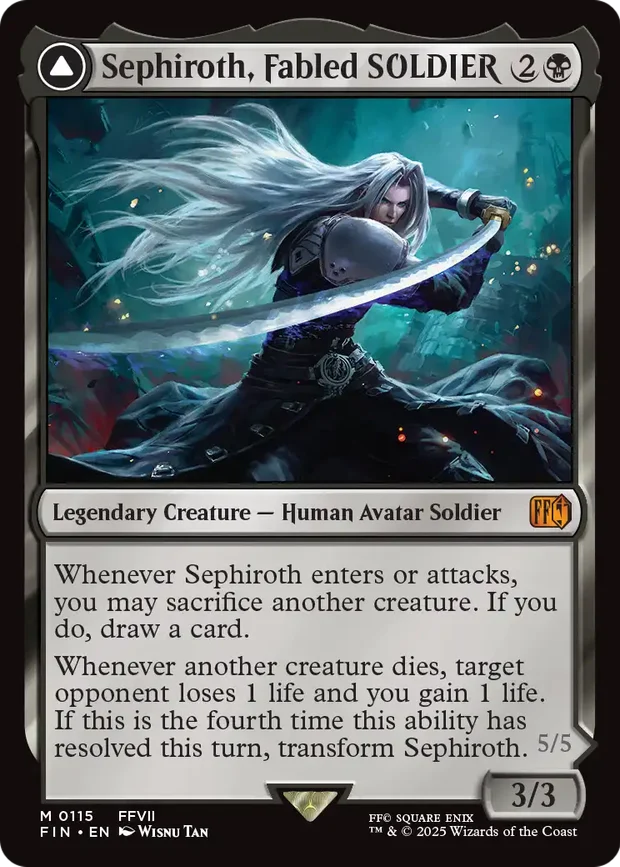
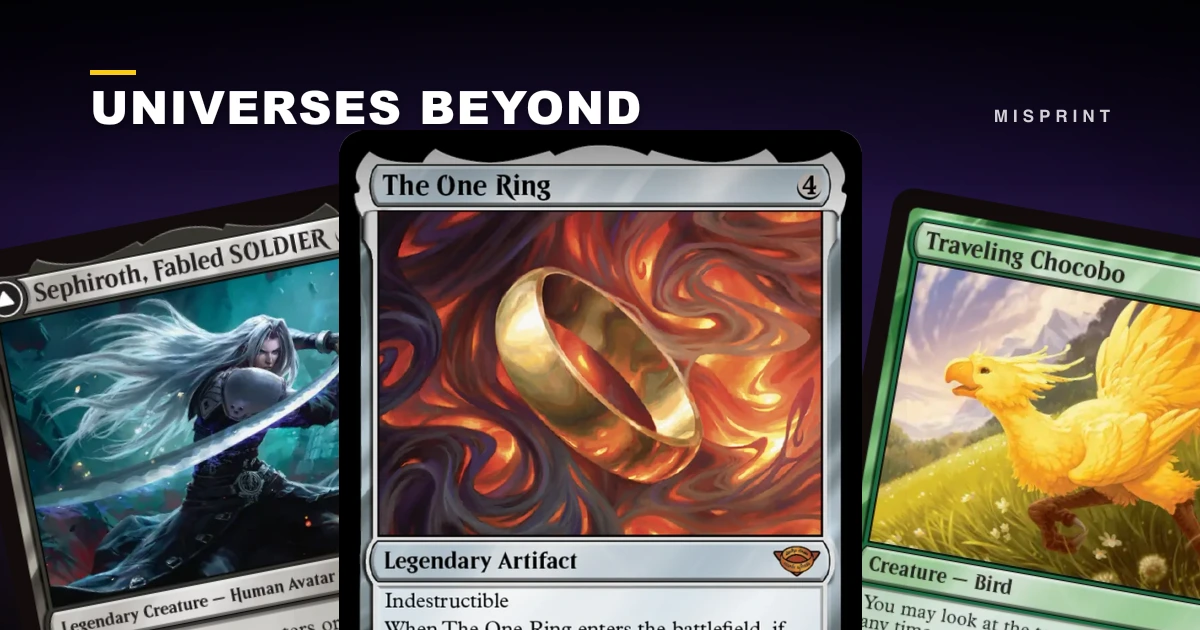
The secondary market went briefly feral. Collector Booster boxes, which normally settle in over time, instead climbed on release, with boxes that opened around $815 at launch pushing past $1,200 as demand outran Wizards' allocations. Individual chase cards followed. The borderless surge foil of Sephiroth, Fabled SOLDIER (the double-faced card that flips into Sephiroth, One-Winged Angel) has traded in the $800 to $980 range, with a market price around $820 in 2026. Lightning, Army of One in surge foil trades around $130, and Kefka, Court Mage has climbed to roughly $215. Mythic surge foils show up in about 3 percent of Collector Boosters, which is the entire point: manufactured scarcity aimed at collectors, not just players.
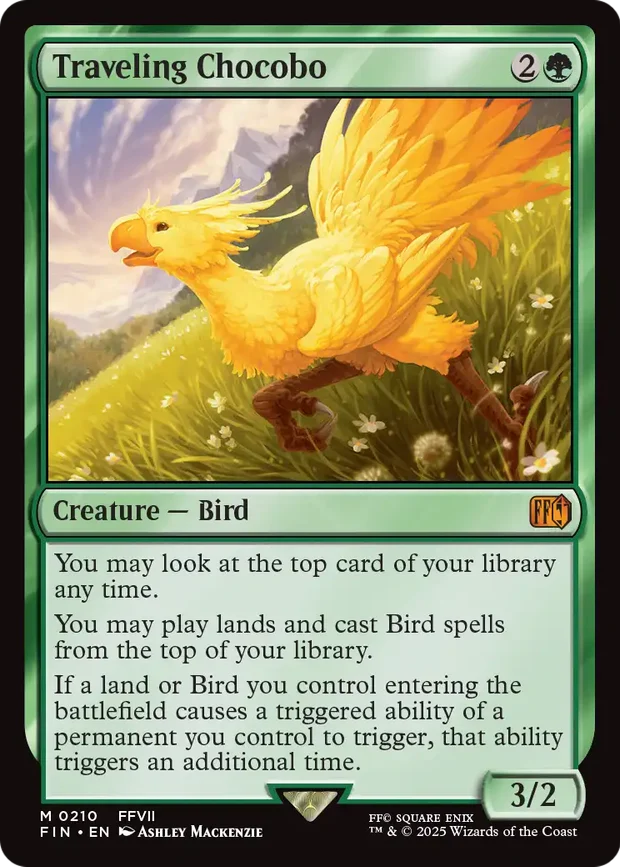
At the very top sits the serialized Traveling Chocobo, the golden chocobo card numbered 1 to 77. Copies have sold from about $40,000 for mid-run numbers to a reported $250,000 for the coveted 1 of 77. As of mid-2026, 43 of the 77 have surfaced, leaving 34 still hidden in unopened product, which keeps a treasure-hunt energy around sealed boxes. Serialization is now a core lever Wizards pulls on nearly every big release, and it is worth understanding on its own terms in Serialized Magic Cards, Explained.
Marvel, and the wall coming down
The other structural shift is about where these cards are allowed to be played. Through 2024, Universes Beyond cards were mostly walled off from Standard, the game's flagship rotating format. That changed with an October 2024 announcement: beginning with Final Fantasy, Universes Beyond tentpole sets became legal in every format, including Standard and Pioneer. The barrier between "real Magic" and "the crossover stuff" effectively dissolved.
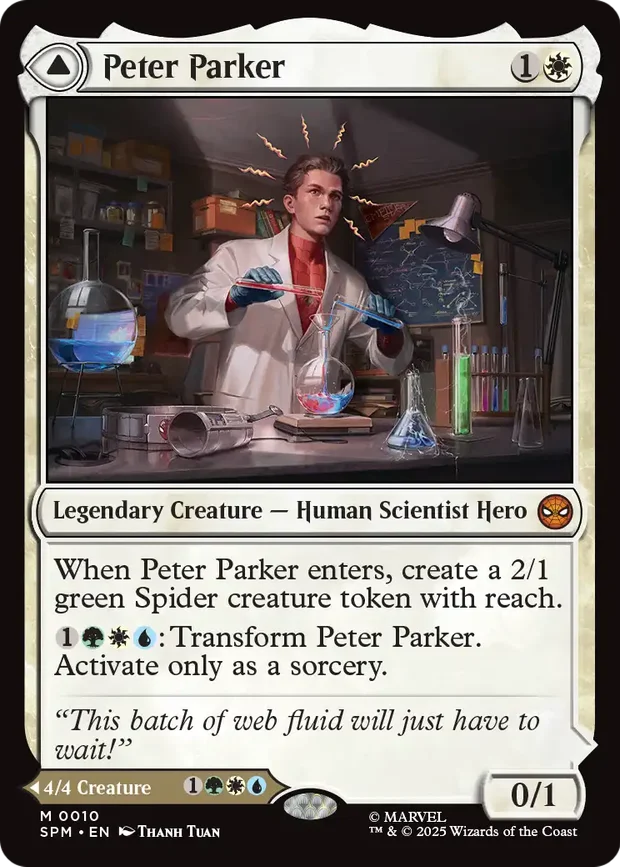
Marvel's Spider-Man, released September 26, 2025, was the first of a multi-year Marvel partnership and counts as Magic's 107th expansion, fully Standard legal. Notably, Wizards did not put the Marvel cards on Magic Online or Arena. Instead it released a mechanically identical, re-skinned Magic-universe version called Through the Omenpaths, a workaround that hints at the licensing tightrope these deals require. The practical effect for collectors is that a Spider-Man rare can now be a tournament staple and a crossover collectible at once, which tends to support prices from two different buyer pools.
What it did to collectors
The upside is real. Universes Beyond has pulled in enormous numbers of new buyers, many arriving for a franchise they already love. Final Fantasy set records for new-player growth. In 2025, three of the seven premier sets were Universes Beyond, and Wizards has signaled a cadence of about three per year continuing through 2027.
The downside is also real, and collectors should weigh it. Head designer Mark Rosewater acknowledged "ongoing complaints" in his 2025 State of Design. The friction points: original Magic-world sets feel overshadowed; supply squeezes and speculator demand price newer players out of Collector Boosters; and there is open worry that IP tourists buy one set and never become durable collectors, which is exactly the kind of demand that can evaporate. For newcomers, that volatility is the whole ballgame. A licensed card's value leans partly on the health of a fandom Wizards does not control, and license terms can expire, which complicates any long reprint history. If you are weighing these as assets rather than keepsakes, read Are Magic: The Gathering Cards a Good Investment? first.
One practical note for anyone tracking this category: graded populations and sold-price data on Universes Beyond chase cards are still thin and move fast, so aggregator prices frequently run ahead of what things actually sell for. Cross-checking recent completed sales against graded-market trackers like Misprint before buying or selling is worth the extra ten minutes. Where these sets rank against each other by collector value is covered in Universes Beyond Sets, Ranked by Collector Value.
The bottom line
Universes Beyond did not just add cards to Magic. It changed the unit of value. The most expensive Magic card ever sold is now a Lord of the Rings promo, the best-selling set ever is a Final Fantasy crossover, and Spider-Man cards are legal in Standard. Whether you find that thrilling or dispiriting, it is the market now. Prices quoted here reflect mid-2026 aggregator data and shift constantly, so treat every figure as a snapshot rather than a promise.