Alpha vs Beta vs Unlimited: How to Tell Them Apart and What They're Worth
The corners, borders, and print runs that separate Magic's three 1993 base sets, and why the gap in value is enormous.
By Misprint Editorial | Published Feb 28, 2026 | 6 min read
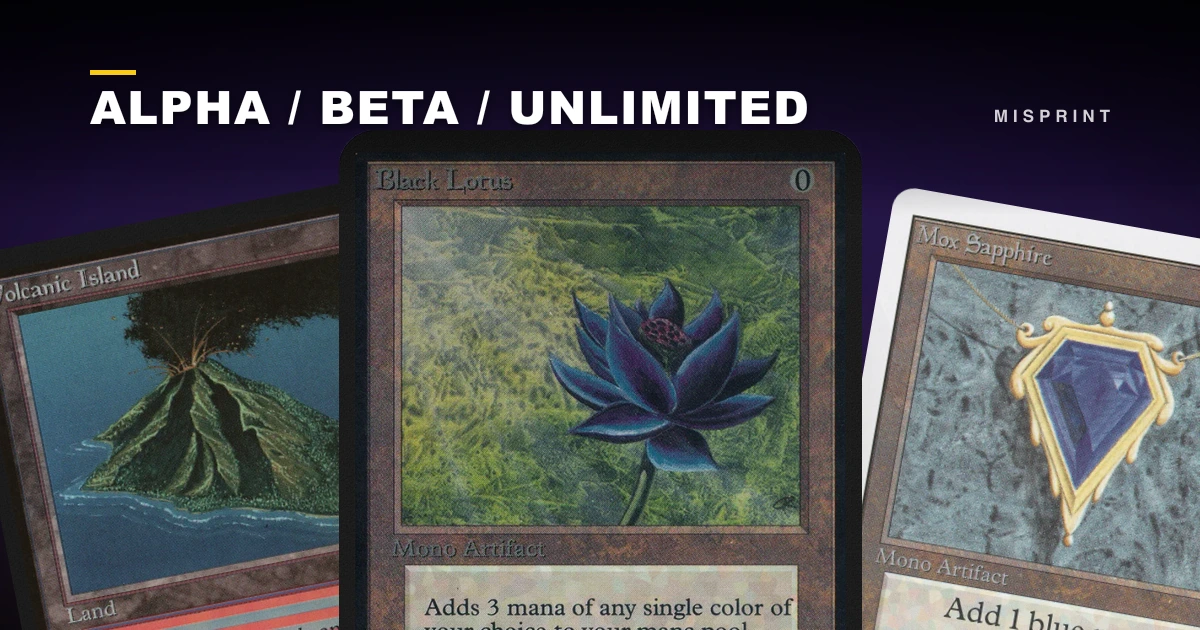
The corners, borders, and print runs that separate Magic's three 1993 base sets, and why the gap in value is enormous.
Three sets of Magic: The Gathering cards came out of Wizards of the Coast in 1993, all sharing the same roughly 300 cards, the same art, and the same rules text. To a new player they look interchangeable. To a collector, the difference between them can be the difference between a $10,000 card and a seven-figure one. The three sets are Limited Edition Alpha, Limited Edition Beta, and Unlimited Edition, and telling them apart comes down to a handful of physical tells you can learn in about five minutes.
Here is how to identify each printing on sight, why they were printed in wildly different quantities, and what that scarcity translates to in the 2026 market.
The short version: what changed and when
Magic launched on August 5, 1993 with Limited Edition Alpha. The print run was roughly 2.6 million cards, and it sold out in a matter of weeks. Demand caught Wizards completely off guard, so they rushed a second printing, Limited Edition Beta, out on October 4, 1993, at about 7.3 million cards. When that also vanished, Wizards printed Unlimited Edition on December 1, 1993, at roughly 40 million cards, this time with a white border specifically so nobody could confuse it with the earlier, scarcer black-bordered runs.
That is the whole story in one sentence: three printings, each one much larger than the last, released within four months of each other. Everything that follows about value flows from those print-run numbers.
Alpha: the rounded corners
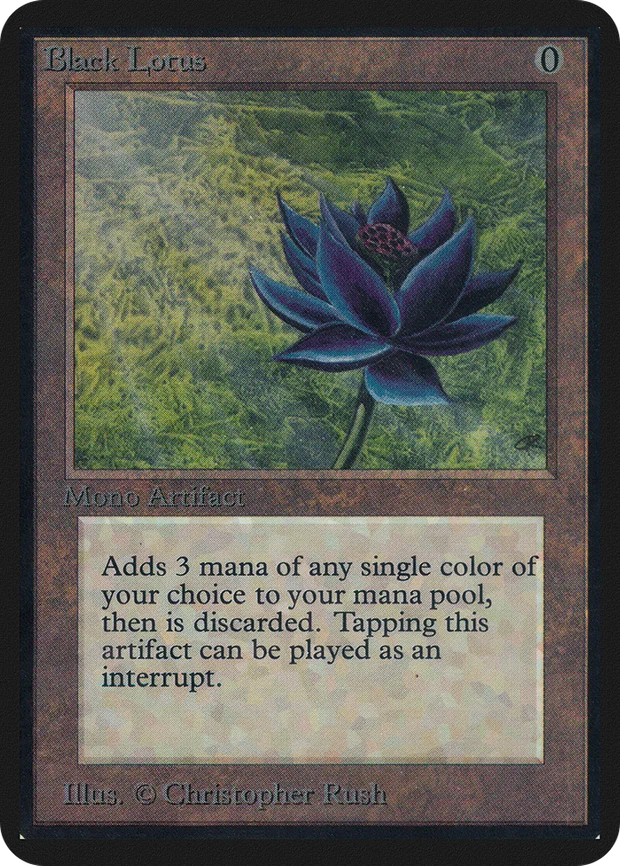
Alpha is the easiest set to identify once you know the tell, and it is the tell that matters most for value. Alpha cards have noticeably rounded corners. Beta and Unlimited cards have tighter, squarer corners, because the cutting die was changed between the Alpha and Beta runs. Hold an Alpha card next to a Beta card and the softer, more rounded Alpha corner is obvious even to an untrained eye.
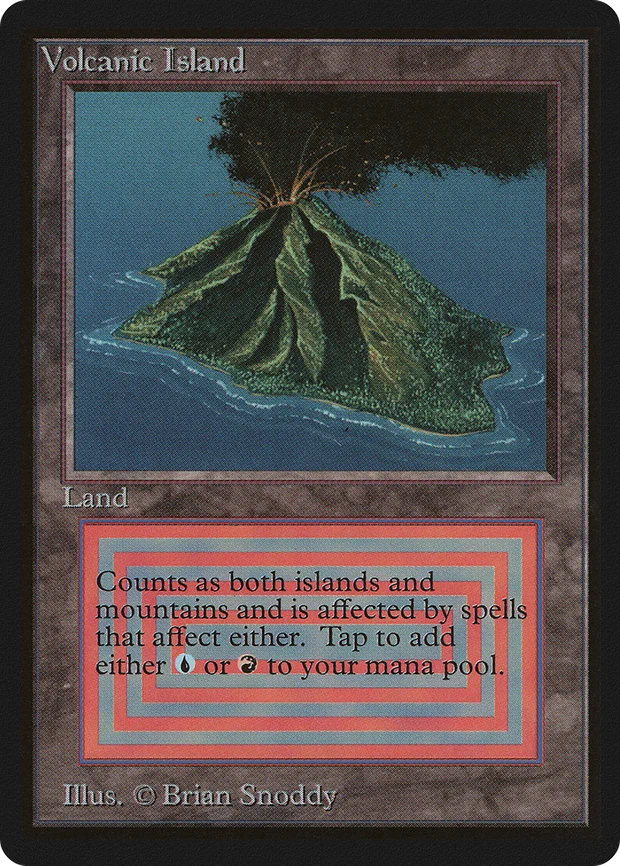
Alpha also has a black border, no copyright line, and no expansion symbol. The only text along the bottom is the artist credit. Beyond corners, there is a content quirk that catches people out: two cards that appear in every later 1993 printing simply do not exist in Alpha. Volcanic Island was left out of the ten-card dual-land cycle because its art was not finished in time, and Circle of Protection: Black was omitted for the same reason. That is part of why the Alpha set has 295 cards while Beta has 302. If someone shows you a rounded-corner Volcanic Island claiming it is Alpha, it is not real.
Beta: black border, sharp corners, the "complete" first run
Beta looks almost identical to Alpha at a glance. Same black border, same lack of copyright line, same artist-only bottom text. The corners are the giveaway: Beta's are squarer than Alpha's. Beta restored the two missing cards and added a second illustration for each of the five basic lands, which is how the count grew from 295 to 302.
Because Beta is the first "complete" printing and still black-bordered, it sits in a sweet spot for a lot of collectors. It is meaningfully more available than Alpha but shares the vintage black-border look that Unlimited lost. For players who want an authentic 1993 card without paying the Alpha premium, Beta is the usual target.
Unlimited: the white border
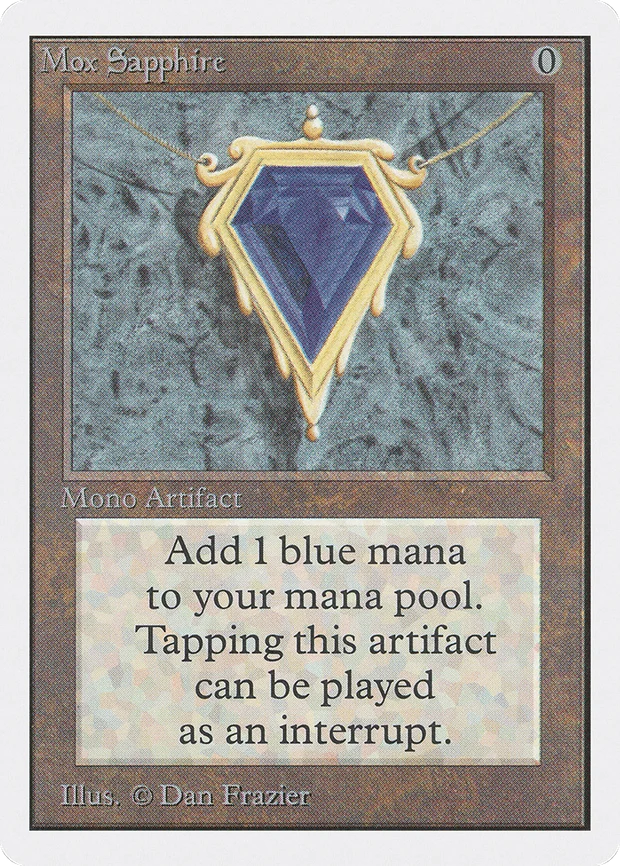
Unlimited is the odd one out and the only set you can identify from across a room. Its border is white, not black. Wizards made that change deliberately, switching the frame to white specifically to protect the collectible value of the two limited black-bordered runs. Everything else about Unlimited matches Beta: same 302 cards, same sharp corners, same layout.
The one card people confuse with Unlimited is Revised Edition (also called 3rd Edition), which shipped in 1994 and is also white-bordered. Three tells separate them. Unlimited has a beveled, slightly 3D inner border, while Revised's inner border is a flat black line. On Unlimited the artist name sits higher, floating well off the bottom border; on Revised it nearly touches the bottom edge. And Unlimited's colors are richer and darker overall, because Revised was printed with a washed-out palette that collectors have complained about for thirty years.
Why the values diverge so much
All three sets contain the Power Nine and the original dual lands, with the lone exception of Alpha's missing Volcanic Island, and every one of those cards is on Magic's Reserved List, meaning Wizards has promised never to reprint them. So the demand side is nearly identical across the three printings. The main variable is supply, and supply differs by more than an order of magnitude between Alpha and Unlimited.
Take the Black Lotus, the most famous card in the game, as the benchmark. As of mid-2026, aggregator and recent-sale data breaks down roughly like this:
- Alpha Black Lotus: raw copies trade in the $35,000 to $80,000 range, and gem-grade examples run into the high six figures. A signed PSA 10 sold publicly for $540,000 in March 2023, and in April 2024 a CGC Pristine 10 changed hands privately for $3 million, the most ever paid for a Magic card. Rapper Post Malone reportedly paid around $800,000 for a signed artist-proof copy back in 2022.
- Beta Black Lotus: raw copies land roughly $18,000 to $35,000, with graded PSA 10 examples generally in the $150,000 to $300,000 band.
- Unlimited Black Lotus: raw copies sit around $6,000 to $12,000, with graded PSA 10 examples generally in the $30,000 to $60,000 band.
The pattern repeats across the marquee cards. An Alpha Ancestral Recall carries an aggregator value around $27,000 against roughly $11,000 for the Beta version, and an Alpha Time Walk sits near $26,000. Original dual lands show the same spread, with Alpha copies commanding a stiff premium over Beta and Unlimited even before you factor in grading.
One caveat worth stating plainly: these are aggregator and recent-sale figures, and aggregator prices often run ahead of what cards actually sell for. Vintage cardboard this thin on supply trades infrequently, so a single strong auction can drag a listed "market price" upward for months. A raw Alpha Time Walk changed hands for around $5,500 in mid-2026, a fraction of its five-figure aggregator value, which tells you how wide that gap can get. Treat the numbers as a map, not a receipt, and check recent sold listings before you buy or sell. It is exactly the kind of graded-market data Misprint tracks for collectors trying to separate real comps from optimistic asking prices.
A quick authentication note
Because the value gulf is so wide, Alpha and Beta cards are among the most-faked in the hobby. The corner shape, border color, and the absence of a copyright line are your first checks, but for a four- or five-figure purchase you want more than a naked-eye pass. A slab from PSA, BGS, or CGC both authenticates and grades in one step, which is why so much high-end vintage Magic changes hands already graded. If you are buying raw, learn the fakes and buy from sellers who will let you inspect corners and borders closely.
Recap
| Set | Released | Print run (approx.) | Border | Corners | Card count |
|---|---|---|---|---|---|
| Alpha | Aug 5, 1993 | 2.6 million | Black | Rounded | 295 |
| Beta | Oct 4, 1993 | 7.3 million | Black | Sharp | 302 |
| Unlimited | Dec 1, 1993 | 40 million | White | Sharp | 302 |
Learn the corners and the border color and you can sort any 1993 card in seconds. The rest, as ever with vintage Magic, is a supply-and-demand story with three chapters printed four months apart.
Prices move constantly and vintage cards trade thinly, so always confirm against recent sold data before acting.