How to Read a Magic: The Gathering Card
Every symbol, number, and line on the card, decoded.
By Misprint Editorial | Published Apr 27, 2026 | 7 min read
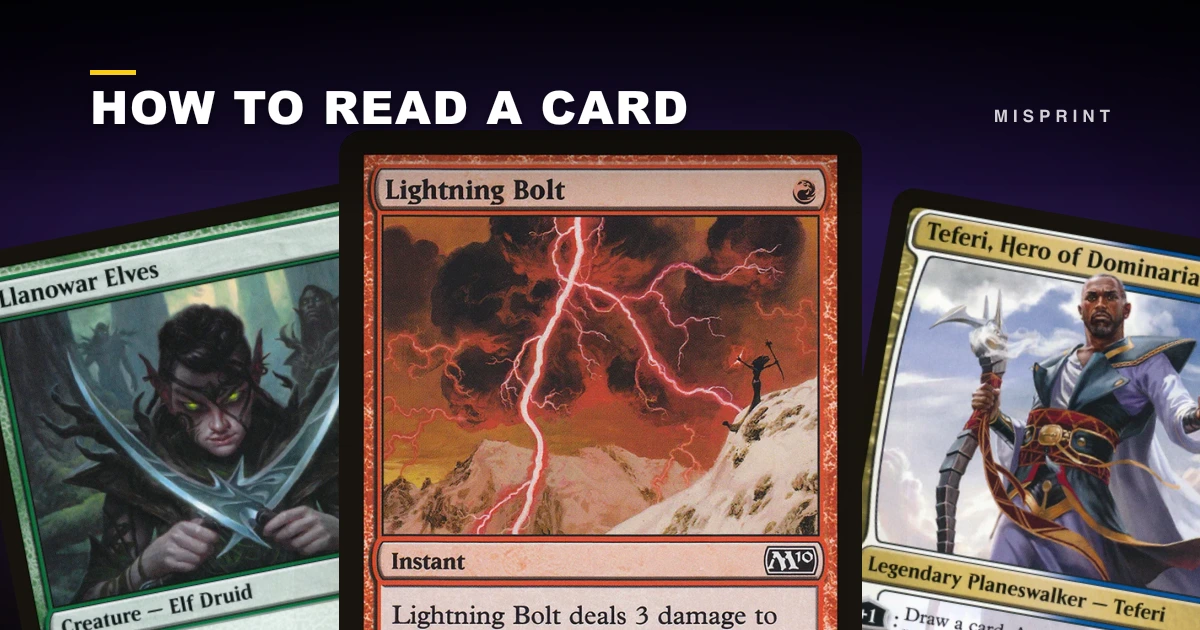
Every symbol, number, and line on the card, decoded.
A Magic card packs a startling amount of information into a piece of cardboard about 2.5 by 3.5 inches. Some of it tells you how to play the card. Some of it tells you which of the many printings you are actually holding, which is the part collectors care about most. Once you know where to look, you can read a card the way a jeweler reads a hallmark: name, cost, type, rules, and then the fine print at the bottom that pins down exactly what it is and roughly what it is worth.
Here is a top-to-bottom tour of the modern card frame, plus the quirks that show up on older cards.
The top line: name and mana cost
The card name runs along the top left. It is the single most important identifier on the card, and in most game rules a card is referred to only by its printed name.
In the top right corner sits the mana cost, written as a string of symbols. A number in a grey circle is generic mana (any color pays for it), and the colored pips stand for the five colors: white (W), blue (U), black (B), red (R), and green (G). So a cost of 1R means one generic mana plus one red. A card with no colored pips in its cost, like most artifacts, is colorless. The total number of symbols, colored or not, is the card's mana value (older players still call this the converted mana cost), and it matters for a surprising number of rules interactions.
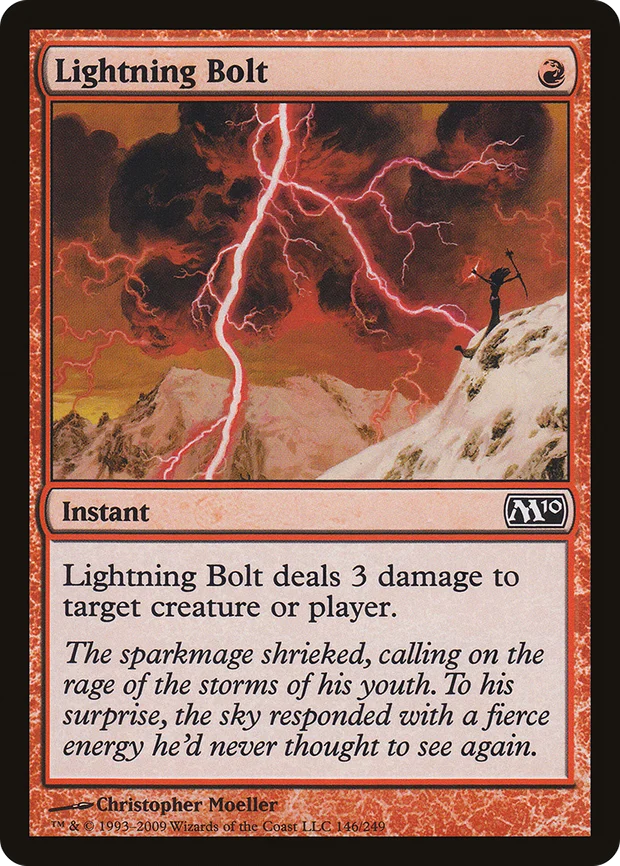
Lightning Bolt is the textbook example. Its cost is a single red pip, and its rules text is one line long, which is a big part of why it has stayed a format staple for more than thirty years.
The illustration and the color of the card
Below the name is the art, and the frame around that art is color-coded to the card's color. White cards sit in a cream frame, blue in blue, black in a dark grey, red in red-orange, green in green. Multicolor cards get a gold frame, and colorless artifacts get a grey-brown one. Lands are usually a tan or brown frame.
That color is not just decoration. A card's color is defined by the colored mana symbols in its cost, and a handful of cards carry a small color indicator (a colored dot to the left of the type line) when they need to be a certain color without having any mana symbols to show it. Double-faced cards and some special printings rely on that dot.
The type line: the busiest line on the card
Directly under the art is the type line, and it is the most information-dense strip on the whole card. Read it left to right.
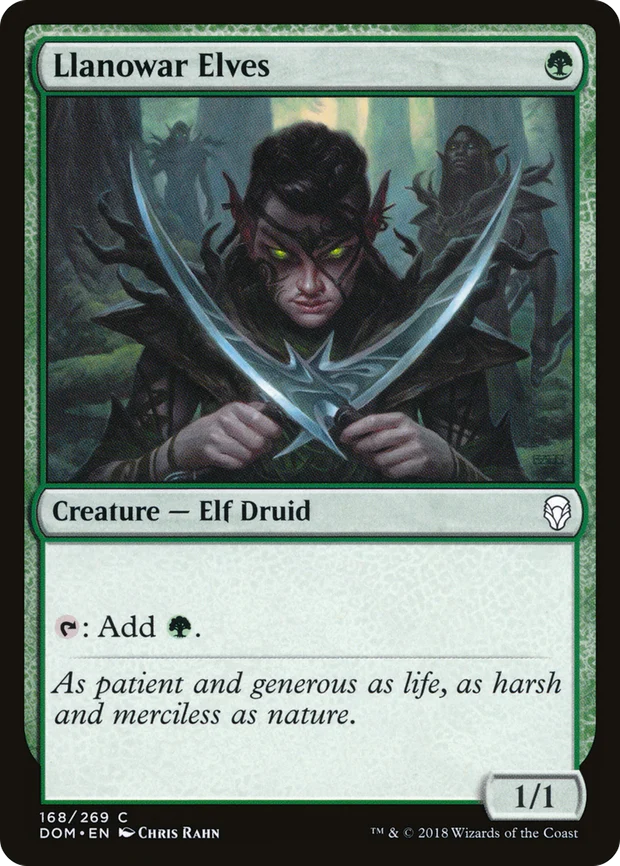
Take a card whose type line reads "Creature" on the left, then a long dash, then "Elf Druid" on the right. That single line contains three kinds of information. "Creature" is the card type, which tells you the basic category (the others include Land, Artifact, Enchantment, Instant, Sorcery, Planeswalker, and Battle). Anything before the card type is a supertype, most commonly "Legendary" or "Basic." Everything to the right of the long dash is a subtype, so "Elf" and "Druid" here are creature types that decks and other cards can care about.
If you can read the type line fluently, you can usually tell what a card does before you even reach the rules text.
The text box: rules, reminders, and flavor
The large box beneath the type line holds the rules text: the abilities that actually make the card function. Keyword abilities like Flying, Trample, or Deathtouch appear here, sometimes followed by italic reminder text in parentheses that restates what the keyword means. Reminder text is a courtesy for newer players and has no rules weight of its own.
Below or between the rules you will often find flavor text, printed in italics and set off from the mechanics. Flavor text is pure world-building and never affects play. A quick way to tell them apart: rules text is upright, flavor text leans.
Power, toughness, and loyalty
Creatures show two numbers in the bottom right corner, separated by a slash, such as 2/1. The first is power (how much damage it deals) and the second is toughness (how much it can take before it dies). A 1/1 Llanowar Elves is fragile but cheap; a 9/9 is a house.
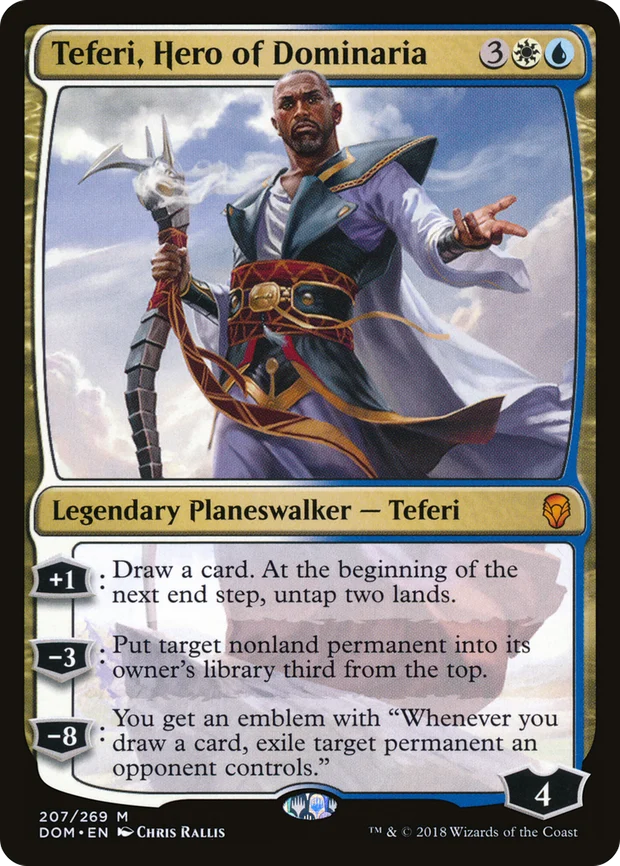
Planeswalkers use that same corner for a single number, the loyalty, which is the resource you spend and gain to use their abilities. Teferi, Hero of Dominaria enters with 4 loyalty. Battles use a defense number in the same spot. So the bottom-right corner always answers the question "how durable is this permanent," it just does it differently by card type.
The bottom line: set symbol, rarity, and collector number
Everything below the text box is identification data, and this is where collecting really begins.
Roughly in the middle of the right edge of the text box sits the set symbol (also called the expansion symbol), a small icon unique to the set the card comes from. Its shape tells you the set. Its color tells you the rarity.
Rarity, read by color
Since the Exodus set in 1998, the set symbol has been color-coded:
- Black symbol: common
- Silver symbol: uncommon
- Gold symbol: rare
- Orange (red-orange) symbol: mythic rare
Mythic rare is the newest tier, introduced with Shards of Alara in 2008, and it is reserved for the flashiest cards in a set: many planeswalkers, marquee legendary creatures, and big splashy spells. Rarity is a design and print-run concept, not a promise of power or value, though it does correlate loosely with both. If you want the full breakdown of how the tiers work and where the newer "special" slots fit in, see Magic Card Rarities Explained: Common to Mythic and Beyond.
The collector line
Starting with the Magic 2015 core set, Wizards standardized a tidy information line in the lower-left corner. It reads something like:
122/269 R on the top, then M15 · EN below, with the artist's name to the right.
Decoded, that is the collector number (card 122 out of 269 in the set), the rarity letter (C, U, R, or M), the three or four letter set code (M15 here), and the language (EN for English). The artist credit sits alongside it. On rare and mythic cards from 2015 onward you will also see a small oval holofoil stamp in the middle of the bottom border, a security feature that helps confirm the card is genuine.
The collector number is the detail serious collectors obsess over, because a high number often signals a special variant. Modern sets tuck alternate arts, borderless treatments, extended-art frames, and serialized cards into number ranges above the "main" set size. A card numbered well past the base set total is almost always a premium version. For how those finishes differ and why some command a premium, see Every Magic Foil Treatment, Explained, and for the question of which of those details actually move price, What Makes a Magic Card Valuable?.
Reading older cards
Pre-1998 cards break the tidy pattern. Original printings from 1993 and 1994 carry no rarity color at all (the set symbol is always black, or missing entirely on the very first sets), and they have no collector number or set code on the card face. That is exactly why telling an Alpha card from a Beta or Unlimited one comes down to subtle frame and corner details rather than any printed label, a puzzle covered in Alpha vs Beta vs Unlimited: How to Tell Them Apart and What They're Worth.
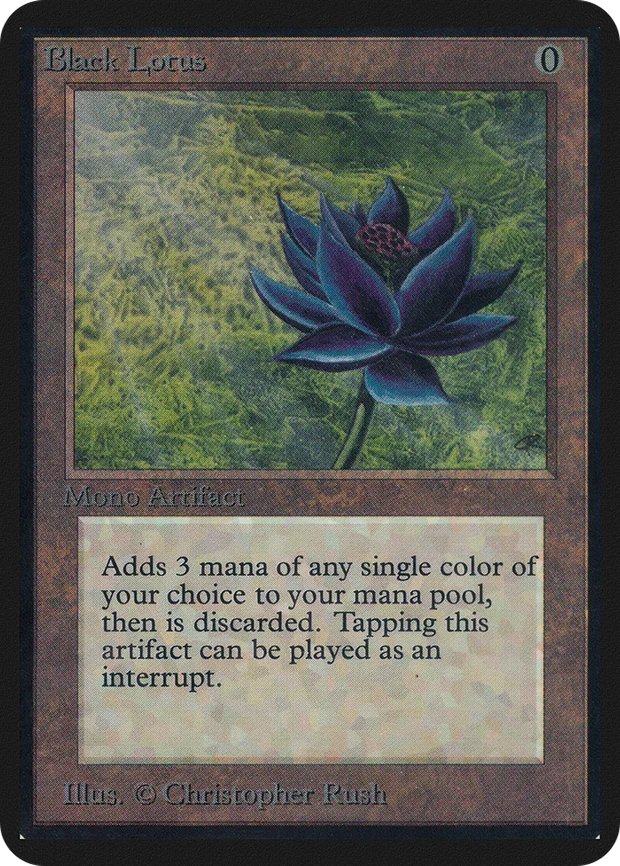
A Black Lotus from Limited Edition Alpha, for instance, tells you almost nothing about itself in print, yet a graded near-mint copy (PSA 7) trades for roughly $30,000 to $50,000, and a pristine PSA 10 gem-mint example set the record at $540,000. Prices like that move constantly, and aggregator listings often run ahead of what cards actually sell for, so treat any single number as a snapshot rather than a quote. At Misprint we track sold prices for graded copies specifically because the printed card gives you so little to go on once you are dealing in vintage.
The quick recap
| Zone | Where | What it tells you |
|---|---|---|
| Name | Top left | The card's identity |
| Mana cost | Top right | What you pay and the card's color |
| Type line | Under the art | Card type, supertypes, subtypes |
| Text box | Middle | Rules text (upright) and flavor text (italic) |
| Power / toughness / loyalty | Bottom right | Durability, by card type |
| Set symbol | Right of text box | Set (shape) and rarity (color) |
| Collector line | Bottom left | Number, rarity letter, set code, language |
Learn those seven zones and no Magic card, from a bulk common to a vintage bomb, is a mystery. If you are just getting your footing, Collecting Magic: The Gathering for Beginners picks up where this leaves off.