What Makes a Magic Card Valuable?
Scarcity, playability, condition, and legend. Five forces set every price.
By Misprint Editorial | Published Jul 15, 2026 | 6 min read
Scarcity, playability, condition, and legend. Five forces set every price.
Two cards printed in the same year can be worth two dollars and twenty thousand dollars. Nothing about the cardboard is different. What separates them is a stack of forces that Magic collectors have been arguing about for three decades: how many exist, how many people want them, what condition they survived in, and whether the card carries a story that outlives any given format. Understanding those forces is the difference between overpaying for hype and spotting a card that is quietly underpriced.
Here is how value actually gets built.
Scarcity: how many exist, and how many ever will
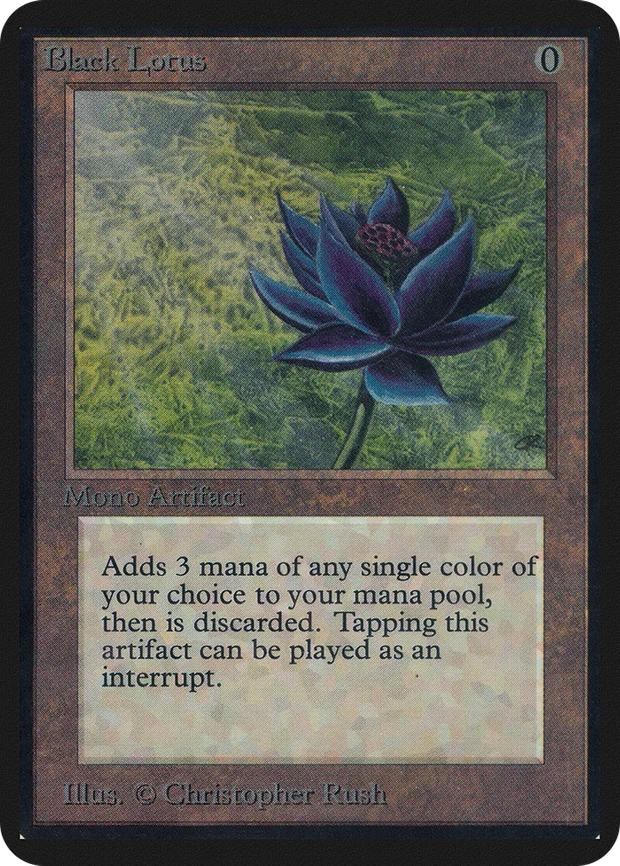
Supply is the foundation. Magic's oldest sets are valuable partly because print runs were tiny and nobody knew the game would last. Alpha, the very first set from 1993, had roughly 2.6 million cards total, and only about 1,100 copies of each rare were ever printed. A Black Lotus from that print run is scarce in a way no modern card can replicate, which is one reason an Alpha copy in a PSA 10 holder set the record at $540,000 in 2023, while a graded example was reported to have changed hands privately for close to $3 million.
But raw print numbers are only half the story. Ongoing supply matters just as much. A card that Wizards of the Coast can reprint every year has a ceiling on its price, because every new printing floods the market and resets demand. That is why print treatment and rarity slot matter: a card that only ever appeared once, in one set, behaves completely differently from a staple that shows up in Standard sets, Commander decks, and reprint sets alike. Scarcity is not just about the past. It is about whether more copies are coming.
Playability: the engine behind most modern prices
For anything printed after the mid-1990s, tournament and Commander demand is usually the single biggest driver. A card that defines a competitive deck gets bought by thousands of players who need four copies, and that consistent demand holds prices up.
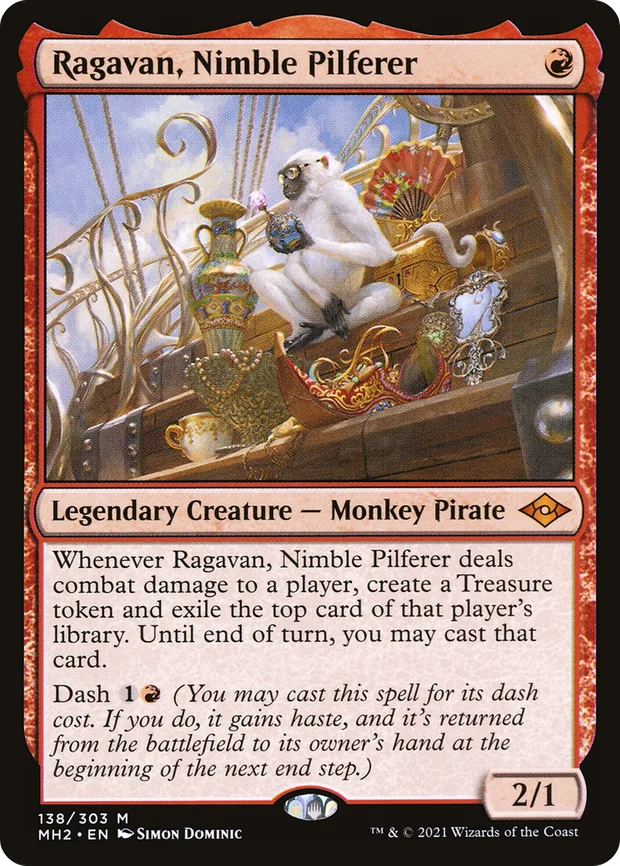
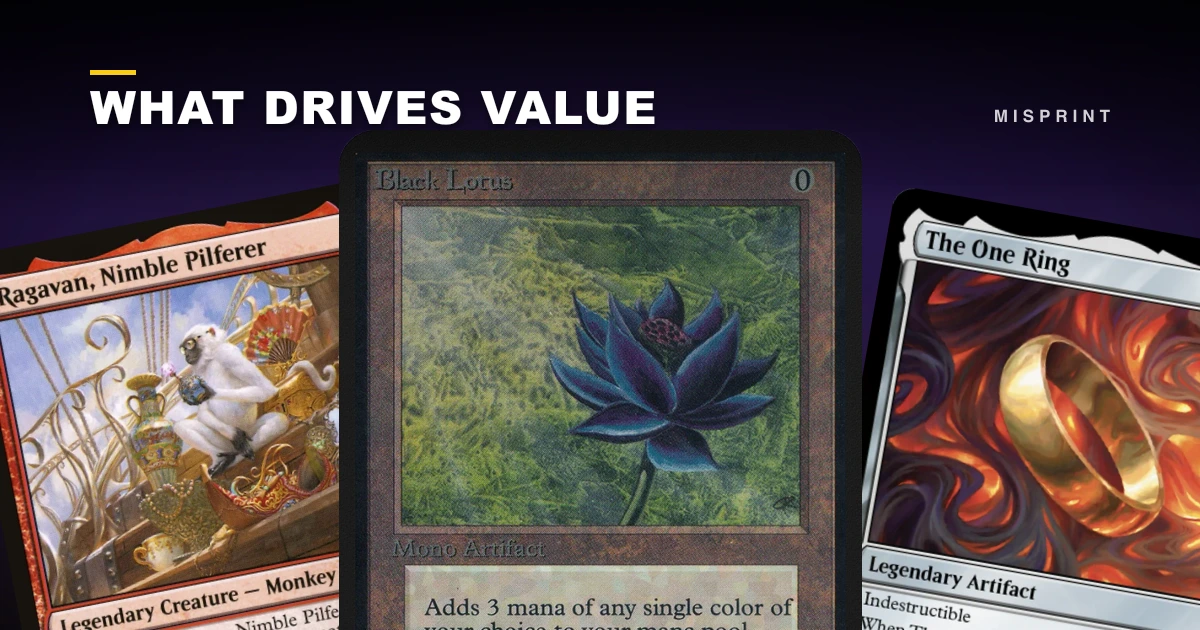
Ragavan, Nimble Pilferer from Modern Horizons 2 is the textbook case. It is not rare in any absolute sense, since Modern Horizons 2 was opened in enormous quantities, yet the non-foil sits around $40 to $50 and foils run roughly $52 to $80 because it is one of the best one-drops in the Modern and Legacy formats. Contrast that with a mythic rare from the same era that never found a competitive home: it can be genuinely harder to find and still sell for a couple of dollars. Demand beats rarity more often than new collectors expect. This is also why playable cards are the volatile ones. A single banned-and-restricted announcement can cut a staple's price in half overnight, which is worth understanding before you treat competitive cards as investments. Our guide to the most valuable Modern cards digs into which staples have held up.
Condition and grade: the same card, five different prices
Once you have decided what a card is, condition decides what your specific copy is worth. The gap is brutal on older cards. Vintage cards were shuffled, taped into decks, and stored in shoeboxes, so a genuinely clean copy is rare on top of an already rare card.
Third-party grading formalizes this. A card sent to PSA, BGS, or CGC comes back in a sealed holder with a numeric grade, and each grade step can multiply the price. An Alpha Black Lotus in a PSA 7 might sell in the $30,000s while a PSA 9 reaches into six figures and a PSA 10 is a different universe entirely. The card is identical. The grade is the entire spread. Centering, surface scratches, edge whitening, and corner wear are what graders punish, and on foils, print lines and clouding matter too. If you are weighing whether to send cards in, our breakdown of whether grading increases a card's value covers when the fee is worth it and when it is not.
Iconic status: the story premium
Some cards are worth more than their scarcity or playability alone would justify, because they have become cultural objects. Black Lotus is the obvious example, but the effect shows up across the game. The serialized one-of-one The One Ring from The Lord of the Rings: Tales of Middle-earth sold to musician Post Malone for a reported figure around $2 million, not because a single ring-shaped piece of cardboard does anything special in a game, but because it was the only one, tied to one of the biggest franchises on earth, and it became a headline.
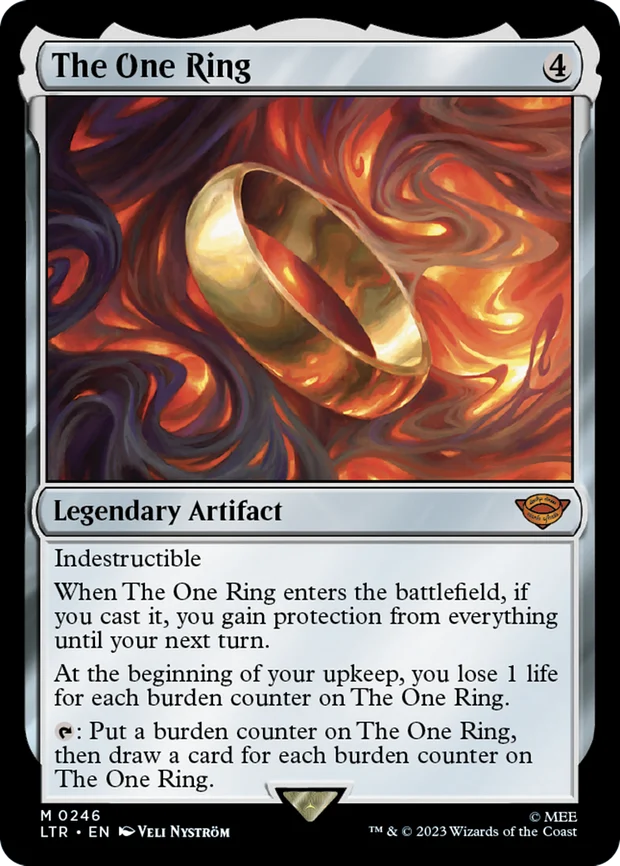
Iconic status is the hardest force to predict and the stickiest once it takes hold. Cards with memorable art, first-of-a-kind mechanics, or a place in Magic's history tend to resist the price crashes that hit purely competitive cards. It is also why serialized cards and first printings command premiums that pure supply math would never explain.
The Reserved List: a promise that props up a whole tier
Layered on top of everything is a policy unique to Magic. In 1996 Wizards published the Reserved List, a set of cards it promised never to reprint in a functionally identical form. That promise removed the single biggest threat to a card's price, which is a future reprint, and it turned a specific group of older cards into a de facto blue-chip tier.
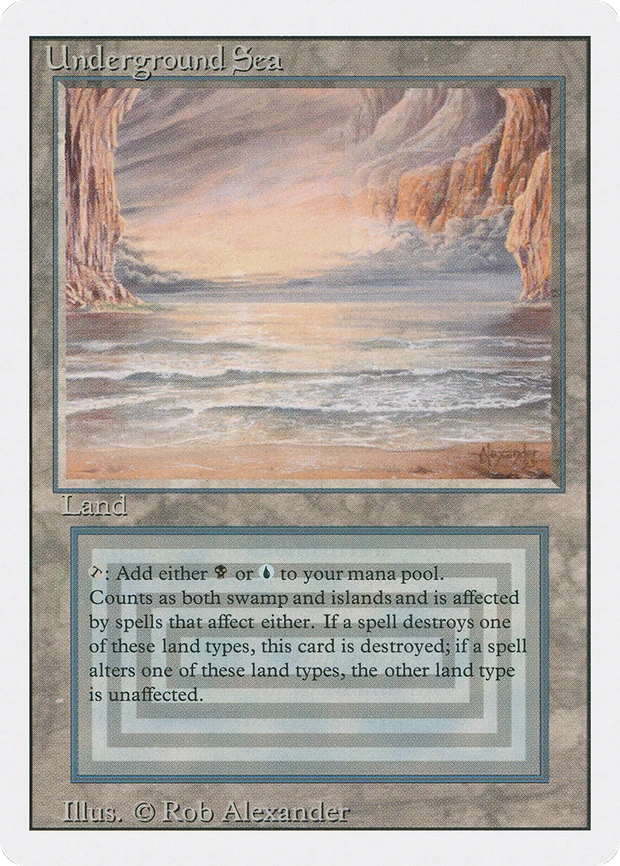
The original dual lands are the clearest beneficiaries. Underground Sea from Revised Edition is not rare the way an Alpha card is, since Revised was a large print run, yet a played copy still runs roughly $700 to $1,000 because it is on the Reserved List, it is a Legacy and Commander staple, and no new supply can ever legally arrive. Scarcity, playability, and a reprint guarantee stacked into one card. The full Reserved List guide explains which cards qualify and why the policy still shapes the high end of the market.
Putting it together
No single factor sets a price. The most valuable cards score high on several at once: a Black Lotus is scarce, iconic, playable in Vintage, and grade-sensitive all at the same time. A cheap card usually fails on the two that matter most, supply and demand, and no amount of nostalgia rescues it. When you are sizing up a card, run it through all five: How many exist and are more coming? Does anyone play it? What condition is this copy in? Does it carry a story? And is it protected from reprints?
A quick note on the numbers above. Aggregator prices from trackers like TCGplayer, MTGStocks, and PriceCharting move constantly, and listed prices often run ahead of what cards actually sell for. Treat any figure as a snapshot, not a quote. Tools that track graded-market sales, Misprint among them, are useful for seeing what genuinely closed rather than what a seller is hoping to get.
| Value factor | What it measures | Card that shows it |
|---|---|---|
| Scarcity | How many exist and whether more are coming | Alpha Black Lotus |
| Playability | Competitive and Commander demand | Ragavan, Nimble Pilferer |
| Condition and grade | The state of your specific copy | Any vintage card, PSA 7 vs 10 |
| Iconic status | Cultural weight beyond gameplay | The One Ring (serialized) |
| Reserved List | A guarantee against reprints | Underground Sea |